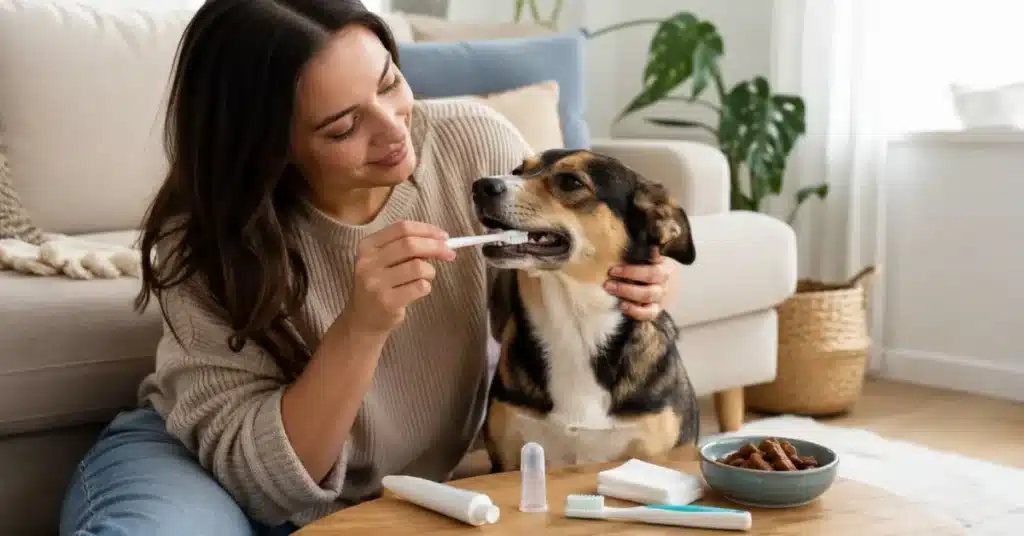
To clean dog teeth at home, use a dog toothbrush or finger brush with dog-safe toothpaste. Gently lift your dog’s lips, brush the outer surfaces of the teeth near the gumline in short, calm sessions, and reward your dog afterward. Never use human toothpaste or force brushing if your dog’s gums are bleeding, swollen, or painful.
Cleaning your dog’s teeth at home may feel difficult at first, especially if your dog does not like anyone touching their mouth. Many first-time dog owners worry about using the wrong toothpaste, brushing too hard, or making their dog afraid of the routine.
The good news is that dog teeth cleaning does not have to be perfect on the first day. Start slowly, use safe tools, and make home brushing part of a healthy dog care routine along with grooming, feeding, exercise, and regular health checks.
Why Cleaning Your Dog’s Teeth Matters
Dog teeth cleaning is not just about fresh breath. It helps support your dog’s daily oral hygiene and may reduce the buildup of soft plaque on the teeth.
Plaque is a sticky film that can collect on your dog’s teeth, especially near the gumline. If it stays there for too long, it can harden into tartar, which is much harder to manage at home.
Poor oral hygiene may also lead to bad breath, red gums, swollen gums, chewing discomfort, or other dental problems. That is why regular home brushing can be a helpful habit for many dogs.
However, home brushing is routine care, not treatment. If your dog already has bleeding gums, loose teeth, heavy tartar, swelling, or pain while eating, you should contact your veterinarian before trying to brush.
A simple way to think about it is this: brushing at home can help support cleaner teeth, but it cannot replace professional dental care when there are signs of a real dental problem. To understand warning signs better, read our guide on signs of dental problems in dogs.
The American Veterinary Medical Association notes that pet dental care includes both veterinary oral health care and home care, such as tooth brushing. This is why brushing at home should support, not replace, professional dental care.
Quick Dog Teeth Cleaning Checklist
Before you start, make sure you have the right tools and your dog is calm. A short, positive session is better than trying to clean every tooth on the first day.
| Before You Start | Why It Matters |
| Dog-safe toothpaste | Safe for dogs to swallow |
| Dog toothbrush or finger brush | Helps clean teeth gently |
| Gauze or soft cloth | Useful if your dog dislikes a brush |
| Small reward treats | Builds a positive habit |
| Calm place | Reduces stress and movement |
| Short session plan | Helps your dog accept brushing slowly |
Do not start brushing when your dog is excited, scared, sleepy, or already showing mouth pain. Choose a quiet time when your dog is relaxed and willing to sit near you.
What You Need to Clean Dog Teeth at Home
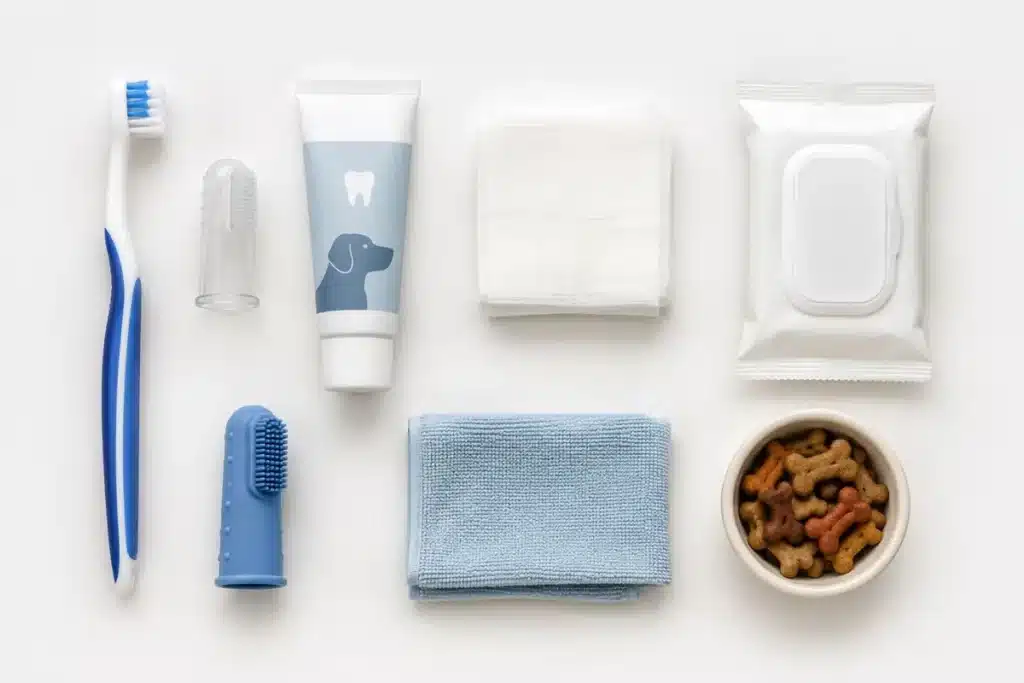
You do not need many tools to clean your dog’s teeth at home, but using the wrong product can create safety problems. The most important rule is simple: use products made for dogs, not human dental products.
Dog Toothbrush
A dog toothbrush usually has soft bristles and a shape that makes it easier to reach your dog’s teeth. Some brushes have a longer handle, which can help with medium or large dogs.
For beginners, choose a soft brush that matches your dog’s mouth size. A brush that is too large may feel uncomfortable, while a very stiff brush may irritate the gums.
If you are not sure where to start, you can compare options in our guide to the best dog toothbrush for beginners.
Finger Brush
A finger brush fits over your finger and gives you more control during the first few brushing sessions. Many new dog owners find it less scary than a long toothbrush.
It can be useful for small dogs, puppies, or dogs that pull away when they see a regular toothbrush. However, use it carefully if your dog tends to bite or snap when their mouth is touched.
Dog-Safe Toothpaste
Always use dog-safe toothpaste. Dogs usually swallow toothpaste instead of spitting it out, so human toothpaste is not a safe choice.
Dog toothpaste often comes in flavors like poultry, beef, or peanut butter. These flavors can make brushing feel more like a reward instead of a stressful task.
Some dog toothpastes are enzymatic, which means they are designed to help support oral hygiene as part of a regular brushing routine. If bad breath is one of your main concerns, you may also want to read our guide to the best dog toothpaste for bad breath.
Gauze or Soft Cloth
If your dog does not accept a toothbrush yet, gauze or a soft cloth can be a gentle starting tool. Wrap it around your finger, add a small amount of dog-safe toothpaste, and touch only the front teeth at first.
This is not always as effective as regular brushing, but it can help your dog get used to mouth handling before you move to a toothbrush or finger brush.
Reward Treats
Reward treats are not just for after brushing. They help your dog connect tooth cleaning with something positive.
Use praise, gentle touch, or a small treat after each successful step. Even if your dog only lets you touch their lips for a few seconds, reward that progress.
A Calm Place
Brush your dog’s teeth in a quiet place where there are fewer distractions. Avoid busy rooms, loud noises, or times when your dog is already excited.
For many dogs, a calm routine matters more than the exact time of day. Try to brush at the same time each day so your dog starts to understand what to expect.
Important Safety Note
Never use human toothpaste, baking soda, or products that contain xylitol on your dog’s teeth. Human toothpaste can contain ingredients that are not meant to be swallowed by pets, and xylitol is dangerous for dogs.
The FDA warns that xylitol is toxic to dogs and may cause serious symptoms, so always check toothpaste and dental product labels before using them.
If you are unsure about a product, check the label and ask your veterinarian before using it.
How to Clean Dog Teeth at Home Step by Step
The goal is to make brushing feel safe, not perfect on day one. Start slowly, use gentle pressure, and stop before your dog becomes stressed.
Cornell’s Riney Canine Health Center notes that brushing your dog’s teeth is one of the most effective home care methods for supporting dental health.
Step 1: Choose a Calm Time
Pick a time when your dog is relaxed. Avoid brushing right after heavy play, mealtime, or a stressful event.
A quiet room can help your dog stay still and focused. Sit beside your dog instead of standing over them, so the process feels less scary.
Step 2: Let Your Dog Taste the Toothpaste
Before using the toothbrush, place a small amount of dog-safe toothpaste on your finger and let your dog lick it.
This helps your dog understand the taste before you start touching the teeth. If your dog likes the flavor, brushing may feel more like a reward.
Do not rush this step. Some dogs need a few short sessions just to accept the toothpaste.
Step 3: Gently Lift Your Dog’s Lips
You do not need to force your dog’s mouth open. In most cases, gently lifting the lips is enough to reach the outer surfaces of the teeth.
Start with one side of the mouth. Keep your hand light and calm. If your dog turns away, pause for a moment and try again later.
Never hold the mouth tightly or force the jaw open. That can make your dog afraid of brushing.
Step 4: Start With the Front Teeth
For the first few attempts, start with the front teeth only. These are easier to reach and less stressful for most dogs.
Brush for just a few seconds. If your dog stays calm, reward them immediately.
Do not worry about cleaning the whole mouth on the first day. Building trust is more important than brushing every tooth right away.
Step 5: Brush the Outer Tooth Surfaces
Focus on the outside surfaces of the teeth, the side that faces the cheeks. This is usually the easiest area to reach at home.
Use small, gentle motions. You can use light circular movements or short strokes, depending on what your dog accepts.
The inside surfaces of the teeth are harder to reach, especially for beginners. Start with the outer teeth first and improve slowly over time.
Step 6: Focus Near the Gumline
Plaque often builds up near the gumline, where the teeth meet the gums. That is why this area needs gentle attention.
Hold the toothbrush at a slight angle toward the gumline and brush softly. Do not press hard.
If the gums look red, swollen, bleeding, or painful, stop brushing and contact your veterinarian before continuing.
Step 7: Keep the First Session Short
Your first brushing session does not need to last long. Even 5 to 10 seconds can be a good start if your dog stays calm.
As your dog gets used to the routine, you can slowly increase the time. The goal is to create a habit your dog can accept.
A short, positive session is better than a long session that ends with fear or resistance.
Step 8: Reward Your Dog Afterward
Always end with praise, gentle attention, or a small treat. This helps your dog connect brushing with something positive.
Reward small progress. If your dog only lets you lift the lips, reward that. If your dog only lets you brush two front teeth, reward that too.
Over time, these small wins can make tooth brushing easier.
Real-Life Example
If your dog lets you brush the front teeth but pulls away when you move toward the back teeth, stop there. Reward your dog and try again tomorrow.
Do not force the back teeth on day one. Instead, slowly build comfort over several sessions. This is often more effective than trying to clean the whole mouth at once.
7-Day Slow Start Method for Dogs That Hate Brushing
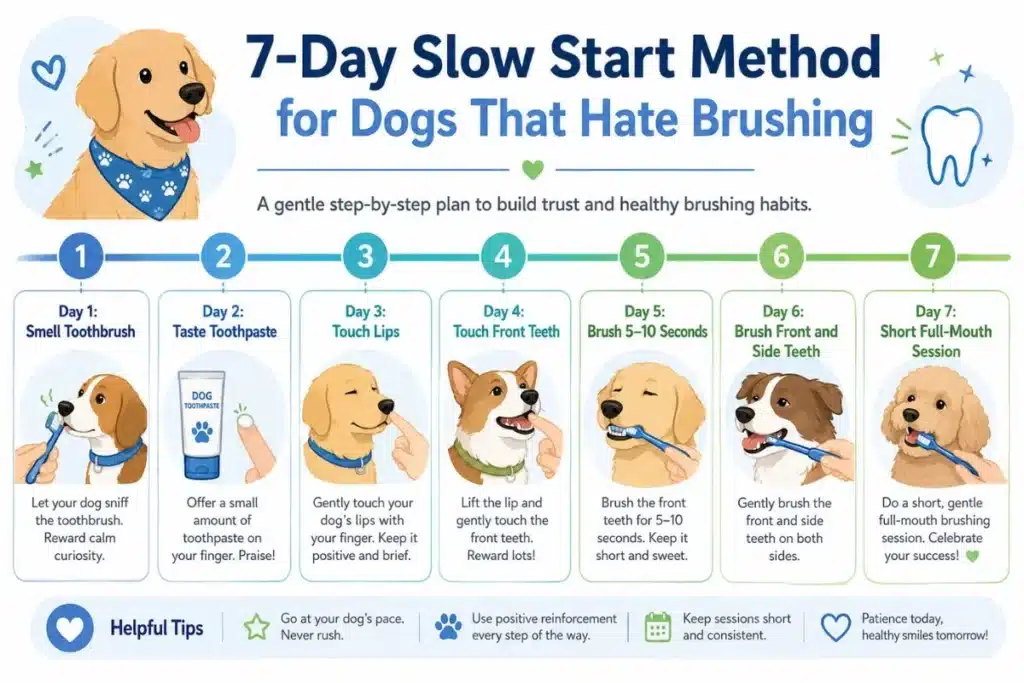
If your dog refuses brushing, slow training works better than force. Many dogs do not accept a toothbrush on the first day, and that is normal.
The goal is to help your dog feel safe with mouth handling before you try a full brushing session.
| Day | What to Do | Goal |
| Day 1 | Let your dog smell the toothbrush | Reduce fear |
| Day 2 | Let your dog lick dog-safe toothpaste | Build taste acceptance |
| Day 3 | Touch the lips gently for 2–3 seconds | Build mouth-touch comfort |
| Day 4 | Touch the front teeth with your finger or gauze | Build teeth-touch comfort |
| Day 5 | Brush the front teeth for 5–10 seconds | First brushing attempt |
| Day 6 | Brush the front and side teeth lightly | Build tolerance |
| Day 7 | Try a short full-mouth session | Start a simple routine |
Do not move to the next step if your dog is scared or resisting. Repeat the same step for a few more days until your dog feels calmer.
A slow start may feel too simple, but it can prevent fear and make brushing easier in the long run.
What If Your Dog Turns Away From the Toothbrush?
A common problem is this: your dog turns away as soon as you bring the toothbrush close.
If that happens, stop using the brush for a few sessions. Let your dog lick a small amount of dog-safe toothpaste from your finger instead.
Then slowly move to touching the lips, touching the front teeth with gauze, and finally using a finger brush or toothbrush.
If your dog only allows 5 to 10 seconds of brushing, that is still progress. Stop early, reward your dog, and try again tomorrow.
For dogs that strongly dislike brushing, you can also read our guide on how to brush a dog’s teeth when they hate it.
How Often Should You Clean Your Dog’s Teeth?
A simple routine matters more than a perfect first attempt. For many dogs, daily brushing is ideal, but beginners can start with a few short sessions each week.
If your dog is new to brushing, do not expect a full routine immediately. Start slowly and build the habit over time.
| Frequency | What to Do |
| Daily, ideal | Brush with dog-safe toothpaste |
| A few times a week | Good starting point for many beginners |
| Weekly | Check breath, gums, tartar, and eating behavior |
| As needed | Use dental wipes or dental chews as support |
| Vet checkups | Ask your vet about your dog’s dental health |
If your dog has red, swollen, bleeding, or painful gums, do not keep brushing just to follow a schedule. Stop and ask your veterinarian what to do next.
What Not to Use on Your Dog’s Teeth
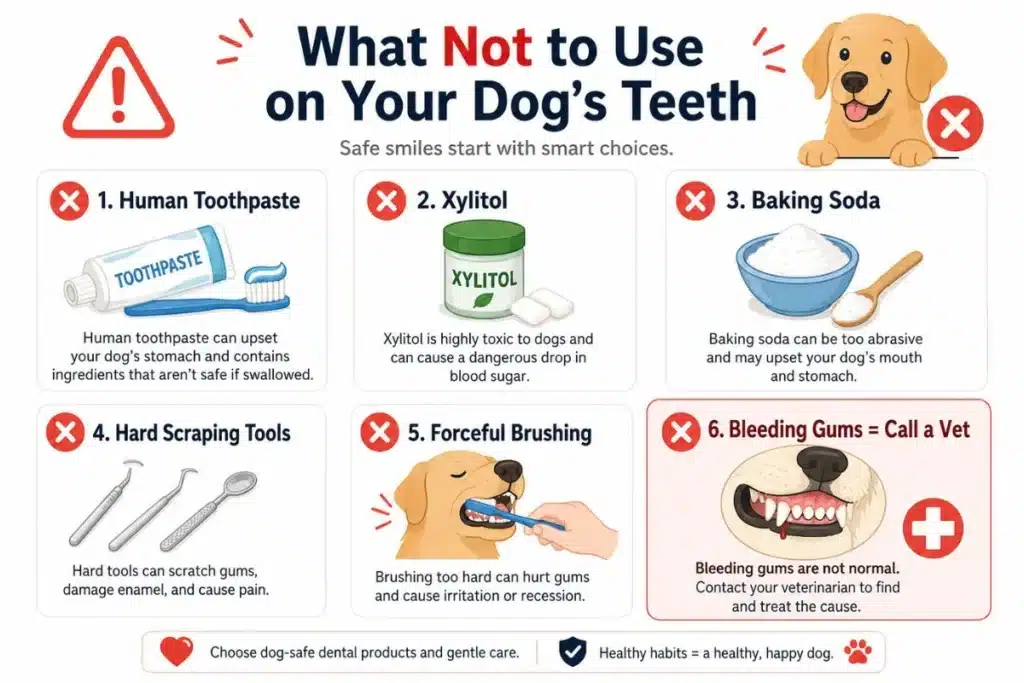
Some common household products are not safe for dog teeth. When you clean dog teeth at home, the safest rule is to use products made for dogs only.
| Avoid | Why You Should Avoid It |
| Human toothpaste | It is not made to be swallowed by dogs and may contain unsafe ingredients |
| Xylitol-containing products | Xylitol is dangerous for dogs |
| Baking soda | It is not a good regular toothpaste choice for dogs |
| Hard scraping tools | They can hurt the teeth or gums |
| Forceful brushing | It can make your dog afraid of brushing |
| Brushing painful gums | Bleeding, swelling, or pain may need vet care |
Never use human toothpaste on your dog. Dogs usually swallow toothpaste instead of spitting it out, so they need dog-safe toothpaste.
You should also avoid trying to scrape tartar off your dog’s teeth at home. If tartar is heavy or hard, it should be checked by a veterinarian.
Home brushing is for routine dental care. It is not meant to treat loose teeth, swollen gums, bleeding gums, oral pain, or dental infection.
If you are unsure about toothpaste safety, read our full guide on can you use human toothpaste on dogs.
Can You Clean Dog Teeth Without Brushing?
You can support your dog’s oral care without brushing, but these methods should not be treated as a full replacement for brushing.
Some dogs need time before they accept a toothbrush. During that training period, dental wipes, dental chews, and water additives may help support oral hygiene.
Dental Wipes
Dental wipes can be useful for dogs that do not like a toothbrush yet. You wrap the wipe around your finger and gently rub the outer surfaces of the teeth.
They may not clean as deeply as brushing near the gumline, but they can be a helpful first step for nervous dogs.
Dog Dental Chews
Dental chews can help keep your dog busy and may support plaque and tartar control when used as directed.
Choose the right size for your dog. A chew that is too small may be swallowed too quickly, while a chew that is too hard may not be suitable for every dog.
If you are comparing options, read our guide on dog dental chews vs brushing.
Water Additives
Some owners use water additives to support fresher breath. These products are added to your dog’s drinking water.
They may help as part of a broader routine, but they should not replace brushing, vet checkups, or proper dental care.
Look for VOHC-Accepted Products
When choosing dental chews, wipes, water additives, or dental diets, look for products with a VOHC seal when possible.
The VOHC seal means the product has met standards for plaque or tartar control when used as directed.
Still, remember this simple rule: dental products can support oral care, but brushing with dog-safe toothpaste remains the main home method for cleaning dog teeth.
If bad breath is your main concern, you may also want to compare dog dental chews for bad breath or dog dental chews for plaque and tartar control.
When to See a Vet for Dog Dental Problems
Home brushing can support oral hygiene, but it cannot replace veterinary dental care when there are signs of a real dental problem.
Stop brushing and contact your veterinarian if you notice any of these signs:
- Bleeding gums
- Red or swollen gums
- Loose teeth
- Heavy yellow or brown tartar
- Severe bad breath
- Drooling more than usual
- Dropping food while eating
- Pawing at the mouth
- Pain while chewing
- Refusing food or eating differently
Bad breath is not always just a smell problem. If your dog’s breath is very strong or suddenly worse, it may be connected to plaque, tartar, gum irritation, or another dental issue.
You should also be careful if your dog reacts with pain when you touch the mouth. In that case, do not force brushing. A vet can check whether brushing is safe or if professional dental care is needed.
For a deeper checklist, read our guide on signs of dental problems in dogs. You can also compare professional dog teeth cleaning vs brushing at home if your dog has heavy tartar or ongoing dental problems.
Common Dog Teeth Cleaning Mistakes Beginners Make
Most brushing problems happen because owners try too much too soon. Start small, stay calm, and build the habit slowly.
| Mistake | Better Approach |
| Trying to brush the whole mouth on day one | Start with the front teeth for a few seconds |
| Using human toothpaste | Use only dog-safe toothpaste |
| Forcing the mouth open | Gently lift the lips instead |
| Brushing too hard | Use light pressure near the gumline |
| Ignoring bleeding gums | Stop and check vet warning signs |
| Thinking dental chews are enough | Use chews as support only |
| Trying to scrape tartar at home | Ask a vet about heavy tartar |
| Not rewarding the dog | Reward every small success |
If your dog has one bad brushing session, do not stop forever. Go back to an easier step, such as letting your dog taste toothpaste or touching the lips gently for a few seconds.
The goal is not perfect brushing right away. The goal is to make dog teeth cleaning feel safe and repeatable.
If you are using dental chews, remember that they can support oral care, but they should not fully replace brushing. Read our guide on dog dental chews vs brushing to understand the difference.
Practical Tips to Make Dog Teeth Cleaning Easier
Small changes can make brushing easier for both you and your dog.
- Use flavored dog toothpaste your dog likes.
- Brush at the same time each day.
- Keep the first sessions very short.
- Start with the front teeth before moving to the back teeth.
- Use a finger brush if a regular toothbrush feels scary.
- Reward your dog after every small success.
- Stop before your dog becomes stressed.
- Ask your vet if your dog’s mouth looks painful.
If your dog only allows 5 to 10 seconds of brushing, that is still progress. End the session calmly and try again the next day.
Over time, these short sessions can become part of a simple dog dental care routine for beginners.
FAQs About Cleaning Dog Teeth at Home
Can I use human toothpaste on my dog?
No. You should not use human toothpaste on your dog. Dogs need dog-safe toothpaste because they usually swallow it instead of spitting it out.
How often should I clean my dog’s teeth at home?
Daily brushing is ideal for many dogs, but beginners can start with a few short sessions each week. If your dog has bleeding, swollen, or painful gums, ask your veterinarian before continuing.
What can I use to clean my dog’s teeth?
You can use a dog toothbrush, finger brush, dog-safe toothpaste, gauze, or dental wipes. For regular brushing, dog-safe toothpaste and a soft dog toothbrush are the best starting tools.
How can I clean my dog’s teeth without brushing?
Dental wipes, dental chews, and water additives may help support oral care, but they should not be treated as a full replacement for brushing.
Are dental chews enough to clean dog teeth?
Dental chews can help support plaque and tartar control when used correctly, but they do not fully replace brushing or regular veterinary dental care.
What if my dog won’t let me brush their teeth?
Start slowly. Let your dog taste dog-safe toothpaste first, then practice touching the lips, then the front teeth, and finally try a toothbrush or finger brush for a few seconds.
Can I scrape tartar off my dog’s teeth at home?
No. Do not scrape tartar off your dog’s teeth at home. Hardened tartar should be checked by a veterinarian because scraping can hurt the teeth or gums.
When should I see a vet for my dog’s teeth?
See a vet if your dog has bleeding gums, swollen gums, loose teeth, severe bad breath, heavy tartar, mouth pain, or trouble eating.
Final Tips for Cleaning Dog Teeth at Home
Cleaning your dog’s teeth at home becomes easier when you start slowly, use dog-safe toothpaste, and keep each session short and calm. The goal is not perfect brushing on day one, but building a routine your dog can accept.
Avoid human toothpaste, forceful brushing, and trying to remove heavy tartar at home. Home brushing is helpful for routine care, but it is not a treatment for serious dental problems.
If your dog has bleeding gums, loose teeth, swelling, severe bad breath, or pain while eating, contact your veterinarian before continuing. For a complete routine, you can also read our guide on dog care for beginners.