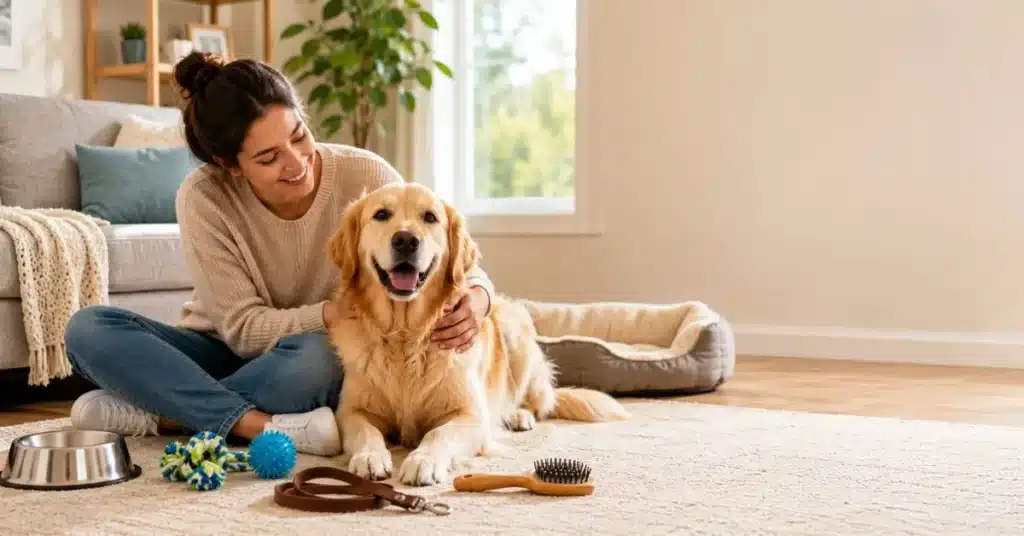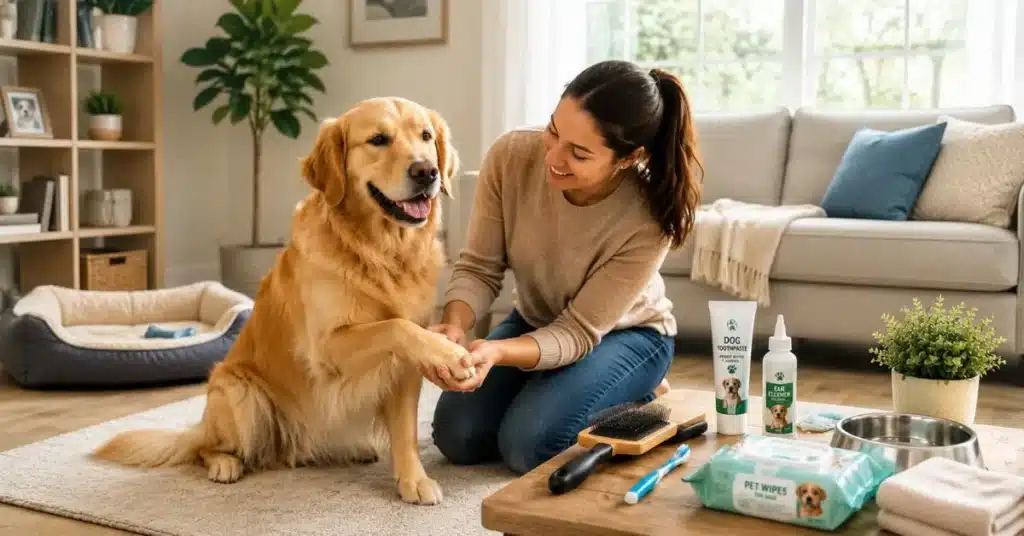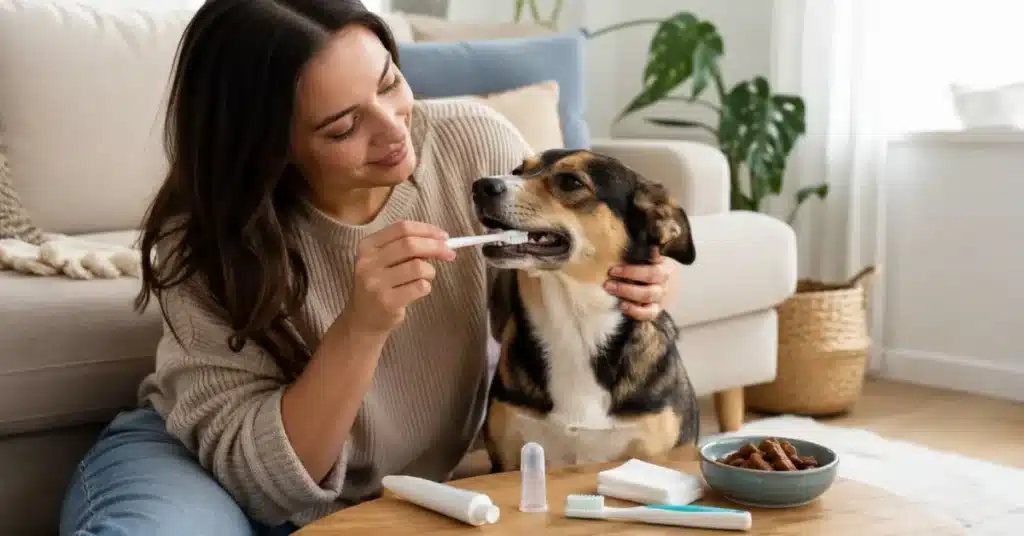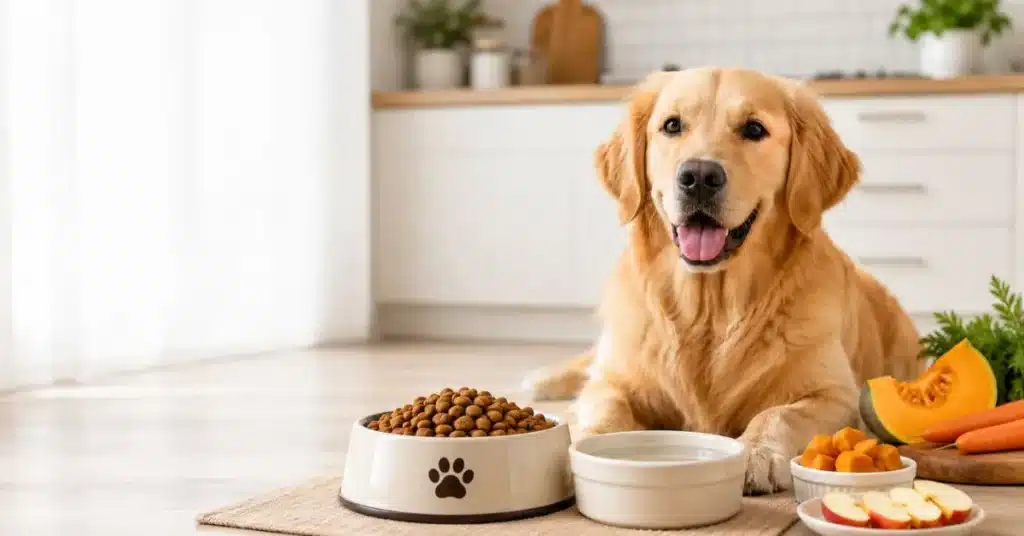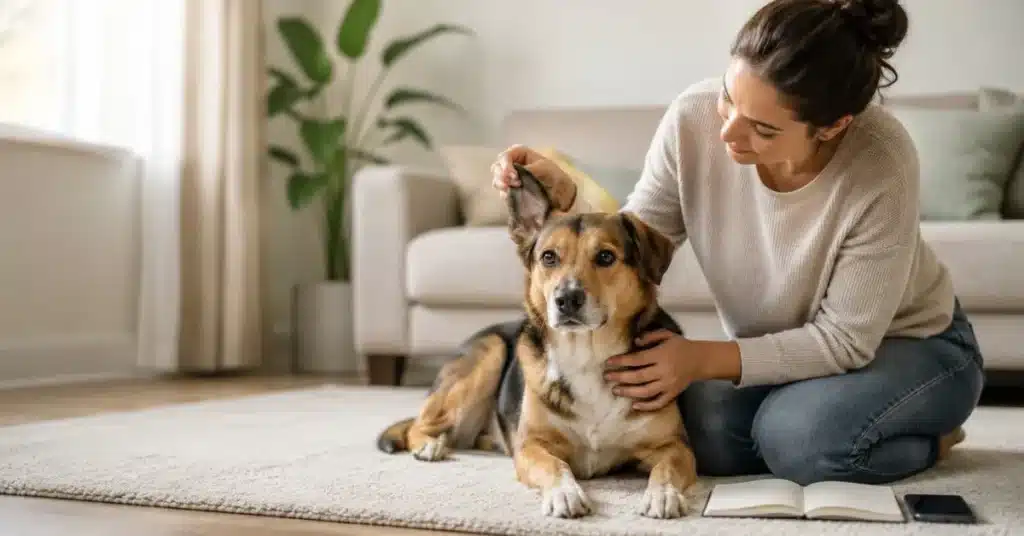
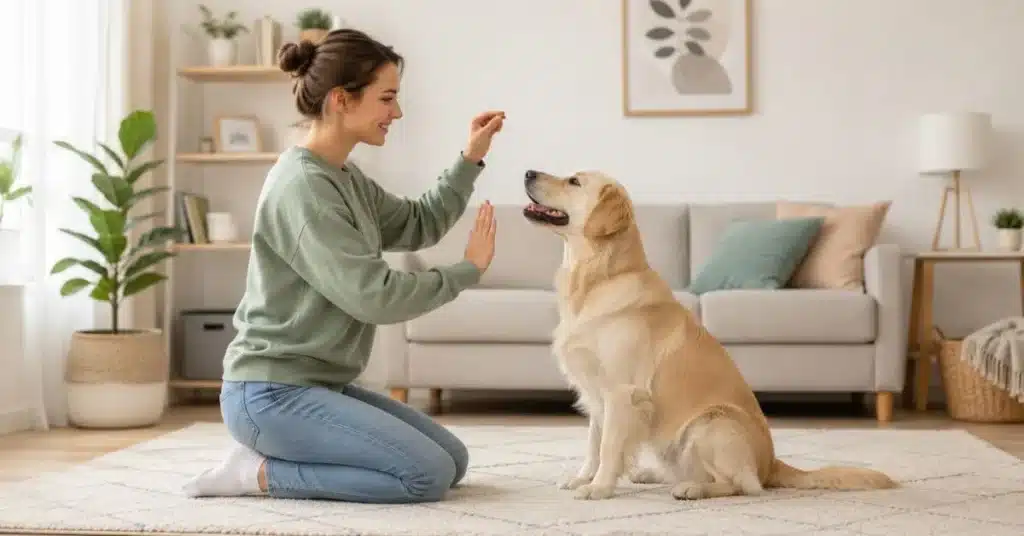
You can train a dog at home by starting with simple commands, short daily sessions, and positive reinforcement. The safest way to train your dog at home is to reward good behavior, practice one command at a time, and avoid yelling, punishment, or force.
Start with basics like name response, sit, stay, come, and down before moving to harder behavior problems. With patience and consistency, many dogs can learn basic manners right at home.
Training is only one part of raising a healthy dog. If you are new to dog ownership, you may also want to read our complete beginner dog care guide to understand daily care, feeding, grooming, exercise, and health basics.
Can You Train a Dog at Home?
Yes, you can train a dog at home without hiring a professional trainer, especially if your goal is to teach basic commands, simple manners, and daily routines. You do not need expensive tools or advanced experience to begin. What you need most is patience, consistency, and a simple training plan.
Home training works best when you start with small, easy lessons. A quiet room, a few soft treats, and 3–5 minutes of focused practice can be enough for one short session.
For beginners, the goal is not to make your dog perfect in one week. The goal is to help your dog understand clear cues, build trust, and learn good habits one step at a time.
At home, you can usually teach your dog:
- Name response
- Sit
- Stay
- Come
- Down
- Loose-leash walking basics
- Simple manners
- Calm behavior around daily routines
However, home training has limits. If your dog shows aggression, biting, extreme fear, sudden behavior changes, or signs of pain, do not try to handle the problem alone. In those cases, speak with a veterinarian or a certified dog trainer.
A good home training plan should make your dog feel safe, not scared. Your dog should learn through rewards, clear cues, and calm practice—not fear, pressure, or punishment.
What Home Dog Training Can and Cannot Do
Home dog training is helpful for building basic obedience, daily manners, and better communication between you and your dog. It can teach your dog what you expect in simple everyday situations, such as sitting before meals, coming when called, or walking calmly on a leash.
However, home training is not a replacement for professional help when a dog has serious behavior problems, sudden behavior changes, or possible health-related issues.
| Home Training Can Help With | Professional Help May Be Needed For |
| Name response | Biting or snapping |
| Sit, stay, come, and down | Sudden aggression |
| Loose-leash walking basics | Severe fear or panic |
| Simple jumping prevention | Resource guarding |
| Daily manners | Pain-related behavior changes |
| Calm routine building | Behavior that gets worse with training |
For example, if your dog does not sit when you ask, that is usually a normal training challenge. You can go back to an easier step, reduce distractions, and practice again with rewards.
But if your dog growls, freezes, snaps, hides, or tries to bite during training, stop the session. These signs may point to fear, pain, stress, or a deeper behavior issue. In that situation, it is safer to speak with a veterinarian or a certified dog trainer before continuing.
Every dog learns at a different pace. A puppy, adult dog, rescue dog, and older dog may all need different levels of time, patience, and repetition.
What You Need Before Training Your Dog at Home
You do not need a full professional setup to start home dog training. Most beginners can begin with a few simple items and a calm training space.
Before your first training session, prepare:
- Small soft treats
- A comfortable leash
- A safe collar or harness
- A favorite toy
- A quiet room with fewer distractions
- A clear marker word like “yes”
- A short training goal for the day
The most important tool is not the treat or the leash. It is your timing. When your dog does the right behavior, reward quickly so your dog understands what earned the reward.
For example, if you ask your dog to sit and they sit, say “yes” immediately and then give the treat. This quick marker helps your dog connect the behavior with the reward.
Choose the Right Training Treats
Training treats should be small, soft, and easy to chew. If the treat is too large, your dog may spend more time eating than learning.
A good training treat should be:
- Small enough for quick rewards
- Soft enough to chew fast
- Interesting to your dog
- Easy to carry during short sessions
- Used only in small amounts during training
Treats are helpful, but they should not become a bribe. A bribe happens when your dog only listens after seeing food first. A reward happens after your dog does the right behavior.
A simple rule is: ask first, mark the correct behavior with “yes,” then reward. This keeps training clear and prevents your dog from depending only on visible treats.
Pick a Quiet Training Place
Start training in a place where your dog can focus. A quiet room, hallway, or calm corner of the living room is better than a park or busy outdoor space.
Many beginners make the mistake of starting outside too early. Outside, your dog may be distracted by smells, people, cars, birds, or other dogs.
If your dog cannot focus indoors yet, they will probably struggle even more outside. Start easy, build confidence, and slowly increase the difficulty as your dog improves.
The Best Method for Beginners: Positive Reinforcement
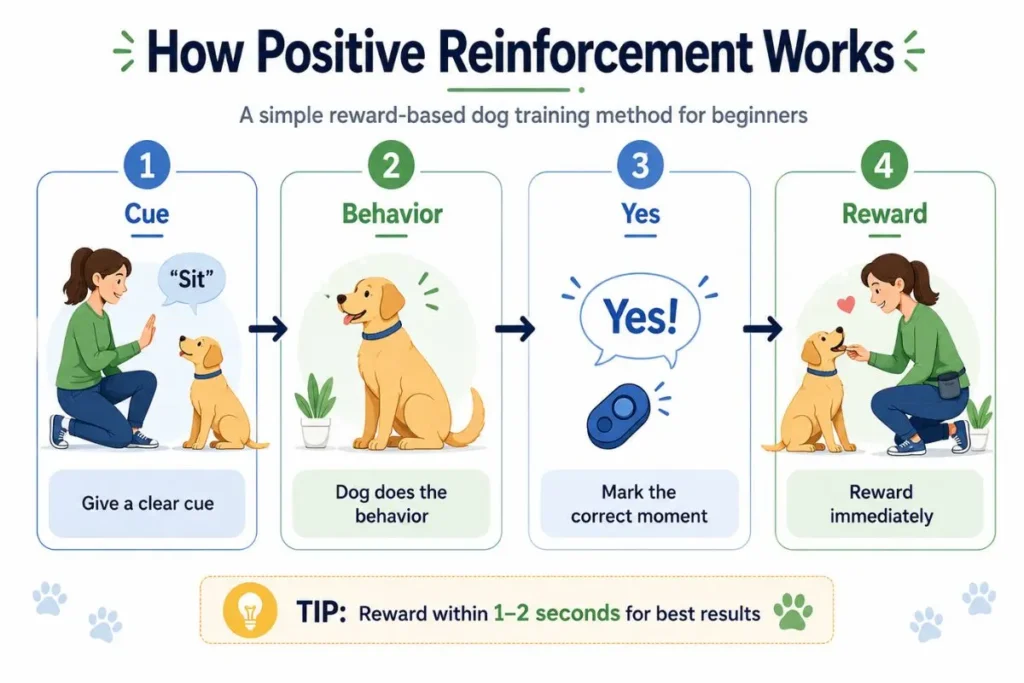
The best beginner-friendly way to train a dog at home is positive reinforcement. This means you reward your dog when they do the behavior you want them to repeat.
Instead of focusing on punishment, positive reinforcement teaches your dog, “This behavior brings something good.” Over time, your dog becomes more willing to listen because training feels clear, safe, and rewarding.
Positive reinforcement is widely recommended by animal welfare organizations because it rewards the behavior you want your dog to repeat. The RSPCA also recommends reward-based training, where dogs receive something they enjoy, such as food, toys, or praise, when they show the desired behavior.
A reward can be:
- A small treat
- Verbal praise
- A favorite toy
- Short playtime
- Access to something your dog enjoys
For example, if your dog sits when you say “sit,” reward that behavior right away. With enough practice, your dog learns that sitting when asked leads to a positive result.
Positive reinforcement works best when you are clear, consistent, and quick with your reward. Use the same cue, reward at the right moment, and keep each session short.
For a deeper guide, read our full article on positive reinforcement dog training.
What Is a Cue?
A cue is the signal you give your dog to ask for behavior. It can be a word, a hand signal, or a sound.
Common dog training cues include:
- Sit
- Stay
- Come
- Down
- Leave it
- Look
Many people use the word “command,” but “cue” is often a better term for beginner dog training. The goal is not to scare your dog into obeying. The goal is to help your dog understand which behavior earns a reward.
What Is a Marker Word?
A marker word tells your dog the exact moment they did something right. It works like a clear signal that says, “Yes, that is the behavior I wanted.”
The easiest marker word for beginners is:
“Yes.”
Here is a simple example:
- Say “sit.”
- Your dog sits.
- Immediately say “yes.”
- Give a small reward.
The word “yes” marks the correct behavior before the reward arrives. This helps your dog learn faster because the message becomes clearer.
Some owners use a clicker instead of a marker word. A clicker can work well, but it is not required. If you are a beginner, using “yes” is simple, free, and easy to start with.
Beginner Tip: Reward your dog within 1–2 seconds of the correct behavior. If the reward comes too late, your dog may not understand what they did right.
What to Avoid When Training a Dog at Home
Most dog training problems come from small mistakes that happen repeatedly. Your dog may not understand the cue, the reward may come too late, or the training session may be too long.
When you train a dog at home, the goal is to make learning clear, safe, and rewarding. Avoid anything that creates fear, confusion, or pressure.
| Avoid This | Why It Can Hurt Training | Better Option |
| Repeating the cue many times | Your dog may learn to ignore the first cue | Say the cue once, then guide gently |
| Training for too long | Your dog may get bored, tired, or frustrated | Use short 3–5 minute sessions |
| Starting in a busy place | Too many distractions make learning harder | Start in a quiet room |
| Showing treats before every cue | Your dog may only work when food is visible | Reward after the correct behavior |
| Yelling or punishment | This can create fear, stress, or confusion | Use calm, reward-based training |
| Pulling or jerking the leash | It can make leash training unpleasant | Reward calm walking and loose-leash movement |
| Punishing growling | This can hide important warning signs | Stop and get help if needed |
Avoid shock collars, prong collars, choke collars, yelling, hitting, or fear-based methods when training your dog at home. These methods are not beginner-friendly and may make some behavior problems worse.
A safer approach is to reward the behavior you want, calmly redirect unwanted behavior, and make the task easier if your dog seems confused. Punishment-based training or confrontation-based methods may increase fear, avoidance, or aggression in some dogs.
Safety Note:
If your dog growls, snaps, freezes, hides, or tries to bite during training, stop immediately. Do not punish warning signs. Speak with a veterinarian or a certified dog trainer before continuing.
Beginner Training Rule: Keep It Short and Easy
A common beginner mistake is trying to teach too much at once. Dogs usually learn better when training feels simple, short, and rewarding.
Start with one cue. Practice for a few minutes. End with something easy.
A good beginner session may look like this:
- 1 minute of name response
- 2 minutes of sit practice
- 1 minute of easy review
- End with praise or play
You can do several short sessions throughout the day instead of one long session. For many dogs, short practice is more effective than a long, tiring lesson.
Beginner Tip:
End each session with an easy success. Even if your dog only gets one small thing right, reward it and finish on a positive note.
Step-by-Step: How to Train a Dog at Home
Now that you understand the basics, it is time to start the actual home dog training process. The best way to train a dog at home is to start simple, use one cue at a time, and reward your dog as soon as they do the right behavior.
Do not rush this process. Your dog does not need to learn everything in one day. A few minutes of calm, successful practice is better than a long session that leaves your dog tired or confused.
Step 1: Start in a Quiet Place
The first step is choosing the right place. Your dog will learn faster in a calm area with fewer distractions.
A quiet room, hallway, or calm corner of your living room is a good place to begin. Avoid starting in a park, busy yard, sidewalk, or place where your dog can see other dogs, people, cars, or birds.
At the beginning, your goal is simple: help your dog focus on you.
A good beginner training area should be:
- Quiet
- Safe
- Familiar
- Free from too many distractions
- Large enough for simple movement
- Comfortable for your dog
If your dog is too excited, sniffing around, barking, or looking everywhere except at you, the place may be too distracting. Move to an easier location and try again.
Beginner Tip:
If your dog cannot focus indoors, they will probably struggle even more outside. Start easy before making the training harder.
Step 2: Teach Your Dog Their Name and Focus
Before teaching commands like sit, stay, or come, your dog should learn to pay attention when you say their name.
This is called name response or focus training. It helps your dog understand that their name means, “Look at me and pay attention.”
Here is a simple way to teach it:
- Stand near your dog in a quiet room.
- Say your dog’s name one time.
- When your dog looks at you, say “yes.”
- Give a small treat immediately.
- Repeat this 5–10 times.
Do not repeat your dog’s name again and again. If you say the name too many times, your dog may learn to ignore it.
If your dog does not look at you, make the task easier. Move closer, use a happier voice, or try a better reward.
Quick Test: Name Response
| Test Step | What to Do |
| Step 1 | Stand in a quiet room |
| Step 2 | Say your dog’s name once |
| Step 3 | Wait for your dog to look at you |
| Step 4 | Say “yes” |
| Step 5 | Reward immediately |
If your dog looks at you 3–5 times in a row, you can move to the next step.
Step 3: Teach Sit
Sit is usually one of the easiest first commands to teach a dog. It is also useful in daily life.
Your dog can sit before meals, before going outside, before greeting people, or when they need to calm down for a moment.
Here is a simple way to teach sit:
- Hold a small treat near your dog’s nose.
- Slowly move the treat upward and slightly back over their head.
- As your dog follows the treat, their bottom may naturally lower.
- When your dog sits, say “yes.”
- Give the treat immediately.
- Repeat several times.
- Add the word “sit” once your dog understands the movement.
Do not push your dog’s back end down. That can make training uncomfortable or confusing. Let your dog choose the movement and reward them when they get it right.
Common Mistake: Many beginners say “sit, sit, sit” before the dog understands the behavior. Instead, help your dog learn the movement first, then add the cue.
For a deeper list of beginner commands, read our guide on basic dog commands.
Step 4: Teach Down
After your dog understands sit, you can teach down. This command helps your dog learn calm body control.
Here is a beginner-friendly method:
- Ask your dog to sit.
- Hold a treat near their nose.
- Slowly move the treat down toward the floor.
- Move the treat slightly forward so your dog follows it.
- When your dog’s elbows and body lower to the ground, say “yes.”
- Reward immediately.
- Repeat a few times before adding the cue “down.”
Some dogs learn quickly. Others may need more time because lying down can feel more vulnerable than sitting.
Do not force your dog into position. If your dog backs away or seems unsure, make the session easier. Reward small steps, such as lowering the head or bending the elbows.
Beginner Tip: Practice down on a soft surface like a rug or mat. Some dogs do not like lying down on slippery floors.
Step 5: Teach Stay
Stay teaches your dog impulse control. It helps your dog learn to wait calmly instead of rushing forward.
Start very small. Do not expect your dog to stay for a long time at first.
Here is how to begin:
- Ask your dog to sit.
- Say stay once.
- Wait for only 1 second.
- Say yes.
- Reward immediately.
- Repeat several times.
- Slowly increase the time by 1–2 seconds.
Once your dog can stay for a few seconds, add a small amount of distance. Take one step back, return to your dog, say yes, and reward.
Do not call your dog out of stay every time. If you always call them, they may learn to break the stay early. Sometimes return to your dog and reward them in place.
| Training Level | What to Build |
| Level 1 | Duration — how long your dog stays |
| Level 2 | Distance — how far you move away |
| Level 3 | Distraction — what happens around your dog |
Do not increase all three at once. If you make the task too hard too fast, your dog may fail and become frustrated.
Step 6: Teach Come
Come is one of the most important commands because it can help keep your dog safe. This is also called recall training.
Start indoors where your dog can succeed.
Here is a simple way to teach come:
- Stand a short distance from your dog.
- Say your dog’s name.
- Say come in a happy voice.
- When your dog moves toward you, praise them.
- When they reach you, say yes.
- Give a high-value reward.
- Repeat from short distances.
Never use come for something your dog dislikes. Do not call your dog and then immediately punish them, end playtime, or force something scary. Your dog should feel that coming to you is always safe and rewarding.
If your dog ignores you, do not chase them. Move closer, reduce distractions, and make the reward better.
Real-Life Example:
If your dog comes when called in the living room but ignores you outside, your dog is not being stubborn. The outside environment is harder. Go back to an easier place and slowly practice around mild distractions.
Step 7: Practice Loose-Leash Walking
Loose-leash walking means your dog can walk beside you or near you without pulling hard on the leash.
This skill takes time because walking outside is exciting for many dogs. There are smells, sounds, people, cars, and other animals. Do not expect perfect walking right away.
Start indoors or in a quiet yard before practicing on a busy street.
Try this basic method:
- Put your dog on a comfortable leash and harness or collar.
- Stand still and wait for your dog to look at you.
- Say yes and reward.
- Take one or two steps forward.
- If your dog walks near you without pulling, reward again.
- If your dog pulls, stop moving.
- Continue when the leash becomes loose again.
Your dog needs to learn that pulling does not make the walk move faster. Calm walking moves the walk forward.
If your dog pulls strongly, coughs, chokes, or seems uncomfortable, check the equipment. Some dogs do better with a properly fitted harness. You can read our guide on how to choose a dog harness.
Safety Note: Do not jerk the leash or drag your dog. Leash training should be calm and reward-based, not painful or scary.
Step 8: Add Distractions Slowly
A dog may understand a command in one room but fail in another place. This does not mean your dog forgot everything. It usually means the situation is harder.
This is where proofing comes in. Proofing means practicing a behavior in different places, with different distractions, and at different difficulty levels.
| Level | Place | Example Goal |
| Easy | Quiet room | Dog responds to name and sit |
| Medium | Living room | Dog listens with mild household noise |
| Medium-Hard | Backyard | Dog listens with outdoor smells |
| Hard | Sidewalk or park | Dog listens around people, dogs, and movement |
Do not jump from a quiet room to a busy park too fast. That can make your dog fail and make you feel frustrated.
Instead, slowly change one thing at a time:
- Add a little more distance
- Add a little more duration
- Add a little more distraction
- Practice in a new room
- Practice near a mild sound
- Practice outside for a short time
If your dog stops listening, go back to the last easy step. That is not failure. That is how training works.
Simple Practice Flow for Each Command
You can use the same basic flow for most beginner commands.
| Step | What to Do |
| 1 | Start in a quiet place |
| 2 | Use one clear cue |
| 3 | Wait for the behavior |
| 4 | Mark it with “yes” |
| 5 | Reward immediately |
| 6 | Repeat a few times |
| 7 | End before your dog gets tired |
| 8 | Practice again later |
This simple flow keeps training clear for your dog. It also helps you avoid the most common beginner mistakes.
How Often Should You Practice?
For many beginners, short daily practice works best. You do not need one long training session.
Try:
- 3–5 minutes per session
- 2–3 short sessions per day
- One command at a time
- A quick review of old commands
- A positive ending
Some dogs can focus longer, while puppies or excited dogs may need very short sessions. Watch your dog’s body language. If they start sniffing, walking away, barking, yawning, jumping, or getting frustrated, it may be time to stop.
Training should feel like a small daily habit, not a stressful test.
Basic Commands to Teach First
When you train a dog at home, it helps to start with a few basic dog commands that are useful in daily life. These commands are not just tricks. They help your dog stay safe, calm, and easier to manage.
| Command | Why It Matters | Beginner Tip |
| Name response | Builds attention and focus | Reward when your dog looks at you |
| Sit | Helps calm behavior | Use before meals, doors, and greetings |
| Down | Helps your dog settle | Practice on a soft surface |
| Stay | Builds impulse control | Start with only 1–2 seconds |
| Come | Important for safety | Always make coming to you rewarding |
| Leave it | Helps avoid unsafe items | Start with low-value objects |
| Loose-leash walking | Makes walks easier | Reward walking without pulling |
You do not need to teach all of these in one day. Start with a name response, then move to sit, down, stay, and come.
Once your dog understands the basics, you can build more advanced skills slowly.
Simple 7-Day Home Dog Training Plan
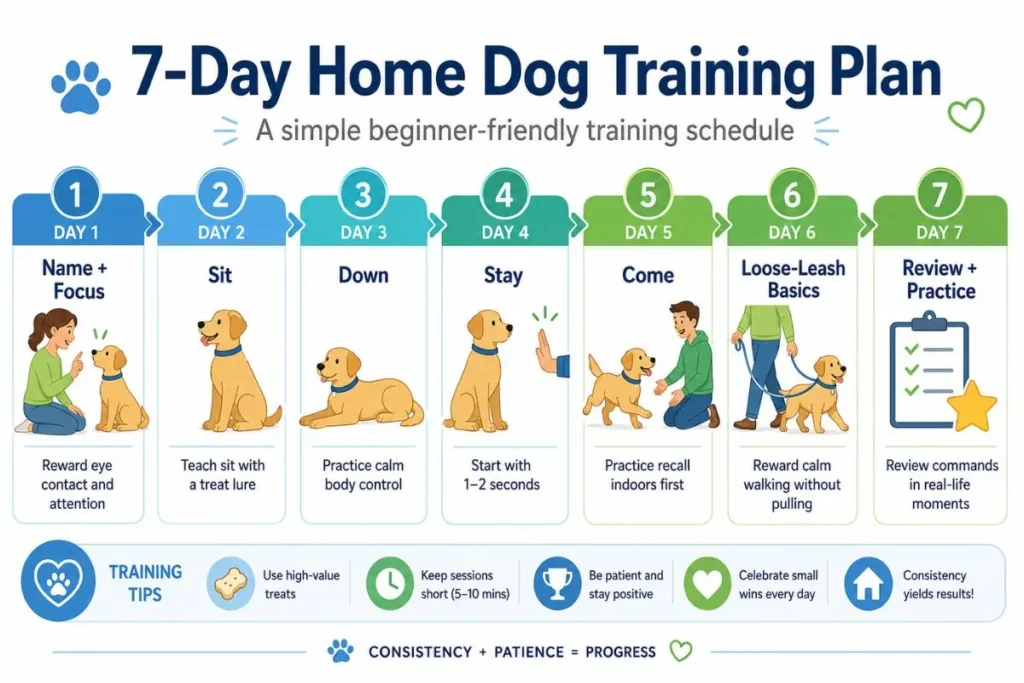
This 7-day dog training plan will not fully train your dog in one week. Instead, it gives you a simple starter routine so you know what to practice first.
Think of this as your first week of building good habits. Keep each session short, calm, and positive.
| Day | Training Focus | What to Practice |
| Day 1 | Name response + focus | Say your dog’s name once, reward eye contact |
| Day 2 | Sit | Use a treat lure, mark with “yes,” reward quickly |
| Day 3 | Down | Start from sit, guide the treat toward the floor |
| Day 4 | Stay | Practice 1–2 seconds, then slowly increase time |
| Day 5 | Come | Call your dog from short distances indoors |
| Day 6 | Loose-leash basics | Reward walking near you without pulling |
| Day 7 | Review + real-life practice | Practice easy commands before meals, walks, and doors |
The goal is not perfection. The goal is to help your dog understand the training pattern:
Cue → behavior → marker word → reward
For example, you say “sit,” your dog sits, you say “yes,” and then you reward. This simple pattern makes learning clearer.
Practice for 3–5 minutes at a time. You can do 2–3 short sessions each day if your dog enjoys it.
If your dog gets bored, distracted, or frustrated, stop early. A short successful session is better than a long stressful one.
You can connect training with your daily dog care routine by practicing before meals, walks, playtime, and bedtime.
Beginner Tip:
Do not move to harder places too quickly. If your dog listens indoors but not outside, go back to an easier level and slowly add distractions.
Common Dog Training Mistakes to Avoid
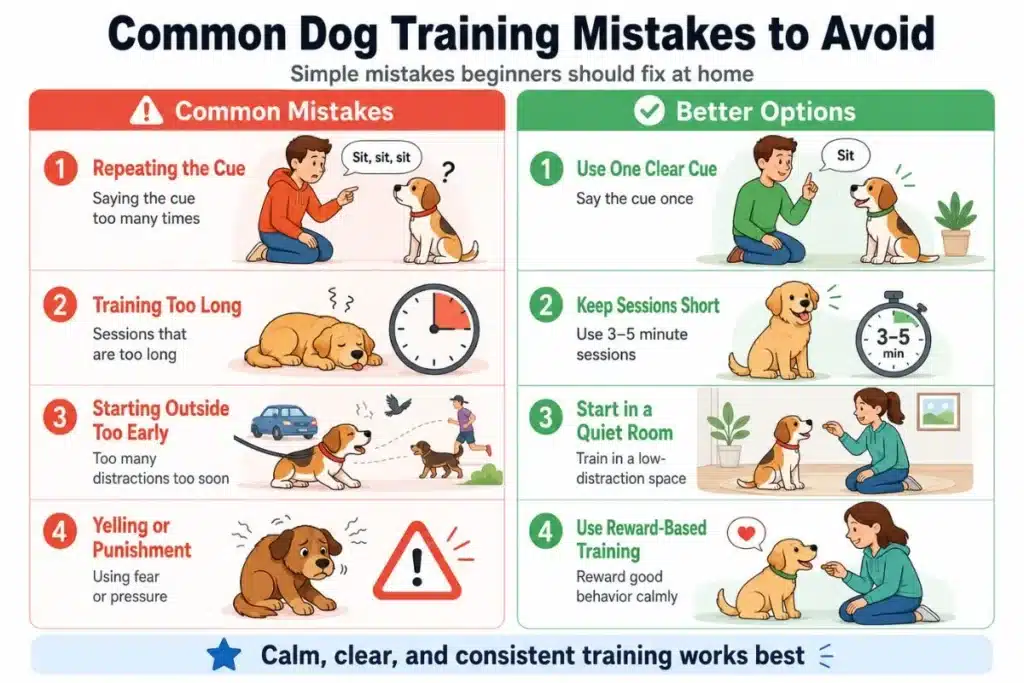
Most dog training mistakes happen because the owner is trying too hard, moving too fast, or using unclear signals. Your dog may not be ignoring you on purpose. They may simply be confused.
| Mistake | Why It Hurts Training | Better Option |
| Repeating the cue many times | Your dog may learn to ignore it | Say the cue once, then help gently |
| Training for too long | Your dog may get bored or frustrated | Use short sessions |
| Starting outside too early | Too many distractions make learning hard | Start in a quiet room |
| Rewarding too late | Your dog may not know what they did right | Reward within 1–2 seconds |
| Using treats as bribes | Your dog may only listen when food is visible | Reward after the behavior |
| Changing cue words | Your dog gets confused | Use the same cue every time |
| Yelling or punishment | Can create fear and stress | Use calm, reward-based training |
Repeating Commands Too Many Times
Many beginners say “sit, sit, sit” or “come, come, come” when the dog does not respond.
This can teach your dog that the first cue does not matter. Instead, say the cue once. If your dog does not understand, make the task easier and guide them calmly.
Training Too Long
A long training session can make your dog tired, bored, or frustrated. Puppies and excited dogs often have very short attention spans.
Keep sessions short. For many dogs, 3–5 minutes is enough. You can always practice again later.
Starting in a Hard Place
A busy park is not a good place to teach a new command. Your dog may be too distracted by smells, movement, people, or other dogs.
Teach the command indoors first. Then practice in the living room, backyard, driveway, and finally outside with more distractions.
Using Treats as Bribes
There is a difference between a reward and a bribe.
A bribe happens when your dog only listens after seeing the treat first. A reward happens after your dog does the correct behavior.
To avoid treat dependence, keep treats hidden sometimes. Ask for the cue, mark the behavior with “yes,” and then reward.
Punishing Fear or Warning Signs
If your dog growls, freezes, hides, or backs away, do not punish them. These can be warning signs that your dog feels scared, stressed, or unsafe.
Punishing warning signs may make the dog stop warning before reacting. That can be dangerous.
If you notice fear, aggression, or biting risk, stop training and get help from a qualified professional.
What If Your Dog Does Not Listen?
If your dog does not listen, do not assume they are being stubborn. Many training problems happen because the task is too hard, the reward is unclear, or the environment is too distracting.
Your first job is to find the reason.
| Problem | Possible Reason | Quick Fix |
| Dog ignores the command | Too many distractions | Go back to a quiet room |
| Dog only listens with treats | Treat is being used as a bribe | Hide treats and reward after behavior |
| Dog gets too excited | Session is too long or reward is too exciting | Take a break and use a calmer reward |
| Dog walks away | Training feels boring or confusing | Make the task easier |
| Dog seems scared | Too much pressure | Stop and restart gently later |
| Dog growls or snaps | Fear, pain, or guarding may be involved | Stop and seek professional help |
| Dog listens indoors but not outside | Command is not proofed yet | Add distractions slowly |
My Dog Listens at Home but Not Outside
This is very common. It does not always mean your dog is disobedient.
Outside is harder. There are new smells, sounds, people, dogs, cars, and movement. Your dog may understand sit in the living room but not yet understand it in a busy outdoor space.
The fix is proofing. Start indoors. Then practice in a different room. Then try the backyard. Then try a quiet sidewalk. Slowly make the training harder.
My Dog Only Listens When I Have Treats
This usually means the treat has become a visible bribe.
To fix this, hide the treat before giving the cue. Ask for the behavior first. When your dog does it, mark with “yes” and then reward.
Over time, reward with treats sometimes and use praise, play, or real-life rewards at other times.
For example, ask your dog to sit before opening the door for a walk. The walk becomes part of the reward.
My Puppy Cannot Focus for More Than Two Minutes
That can be normal. Puppies are young, curious, and easily distracted.
Use very short sessions. Even 1–2 minutes can be enough for some puppies.
Keep the lesson simple and end before your puppy becomes tired or wild. For puppy-specific help, read our guide on puppy training at home.
My Dog Gets Too Excited During Training
Some dogs become too excited when treats or toys appear. They may jump, bark, grab, or spin around.
Try lowering the excitement level. Use smaller treats, a calmer voice, and slower movement.
You can also ask for easy behavior like sit before continuing.
My Dog Growls During Training
Growling is a warning sign. Do not punish it.
Stop the session and think about what happened. Was your dog scared? Were you too close? Did you touch something valuable? Could your dog be in pain?
If growling, snapping, or biting risk continues, get help from a veterinarian or certified trainer. You can read more about warning signs in our guide on why your dog is suddenly aggressive.
Real-Life Training Examples
Real home training is not always perfect. Your dog may do well one day and struggle the next. That is normal.
Example 1: Your Dog Sits Before Meals but Jumps on Guests
This means your dog understands sit in one situation, but not yet in a more exciting situation.
Practice sit when the doorbell rings, when a family member enters the room, or before greeting someone. Start with calm people before trying it with guests.
Example 2: Your Dog Comes Indoors but Ignores You in the Yard
Your dog may not be ready for outdoor recall yet.
Go back to short distances indoors. Then practice in the yard with a long line and better rewards. Do not expect outdoor recall to be perfect too soon.
Example 3: Your Dog Pulls Hard at the Start of Every Walk
Your dog may be too excited before the walk even begins.
Practice calm behavior before opening the door. Ask for sit, reward calmness, then step outside. If your dog rushes, pause and reset.
Puppy vs Adult Dog Training at Home
Training a puppy and training an adult dog are similar in many ways, but the pace can be different. Both puppies and adult dogs can learn with positive reinforcement, short sessions, and consistent practice.
The main difference is attention span, past habits, and life experience.
| Dog Type | Training Note | Best Approach |
| Puppy | Short attention span, high curiosity | Use very short, frequent sessions |
| Adult dog | May already have habits | Be patient and repeat calmly |
| Rescue dog | May need trust-building first | Go slowly and avoid pressure |
| Older dog | Can still learn new skills | Use gentle practice and realistic goals |
Training a Puppy at Home
When you train a puppy at home, keep the sessions very short. A puppy may only focus for 1–3 minutes at first, and that is normal.
Start with simple routines:
- Name response
- Sit
- Come
- Potty routine
- Crate comfort
- Gentle leash introduction
- Socialization
Puppies also need safe exposure to normal life. This can include household sounds, visitors, grooming touch, car rides, and calm outdoor experiences.
Do not overwhelm your puppy. Socialization does not mean forcing your puppy to meet every dog or person. It means helping your puppy feel safe around new things.
Training an Adult Dog at Home
Adult dogs can absolutely learn new behaviors. The idea that an older dog cannot learn is not true.
However, adult dogs may need more repetition if they have practiced the same habit for a long time. For example, if your dog has pulled on the leash for years, loose-leash walking may take time.
Start with easy wins. Reward small improvements. Do not expect overnight change.
Adult dog training works best when you:
- Use clear cues
- Keep rewards consistent
- Practice in calm places first
- Avoid punishment
- Repeat daily
- Slowly increase distractions
Training a Rescue Dog at Home
A rescue dog may need extra patience. Some rescue dogs adjust quickly, while others need time to feel safe.
Before pushing training, focus on trust. Let your dog learn your routine, your voice, your home, and your expectations.
Keep early training gentle and predictable. Avoid loud corrections, physical pressure, or forcing your dog into scary situations.
If your rescue dog shows fear, growling, resource guarding, or sudden aggression, get help from a veterinarian or certified trainer.
How to Maintain Your Dog’s Training
Training does not stop when your dog learns a command once. To keep the behavior strong, you need to practice it in real life.
A dog may know sit in the kitchen but forget it when guests arrive. That does not mean training failed. It means the behavior needs more practice in different situations.
The best way to maintain training is to make it part of your dog’s daily routine.
Try using commands:
- Before meals
- Before opening the door
- Before putting on the leash
- Before playtime
- Before greeting guests
- During walks
- Before bedtime
For example, ask your dog to sit before you put the food bowl down. Ask for stay before opening the front door. Practice come from another room before giving praise or play.
These small moments help your dog understand that training is part of everyday life.
You can connect this habit with your daily dog care routine so training becomes a simple daily practice.
Slowly Fade Treats
Treats are useful when your dog is learning a new behavior. But your dog should not depend on seeing food every time.
Once your dog understands a command, you can slowly reduce treat rewards and use:
- Praise
- Petting
- Toys
- Play
- Walks
- Door opening
- Food bowl release
- Sniffing time outside
These are called real-life rewards. They help your dog learn that listening can lead to many good things, not just treats.
When Should You Get Professional Help?
Home training is useful for basic commands, manners, and daily routine. But some problems should not be handled by trial and error.
You may need a veterinarian, certified dog trainer, or veterinary behaviorist if your dog:
- Bites or tries to bite
- Shows sudden aggression
- Growls when touched or approached
- Guards food, toys, bed, or people
- Freezes, hides, or panics during training
- Seems painful or suddenly changes behavior
- Becomes more fearful with training
- Snaps when corrected
- Shows severe anxiety
- Gets worse despite gentle training
Behavior problems can have many causes. A dog may act aggressive because of fear, pain, stress, anxiety, poor socialization, or past experiences.
Trying to force training at home can make the problem worse.
If you decide to work with a trainer, choose a dog trainer who uses positive reinforcement, explains their training methods clearly, and has experience with your dog’s specific behavior issue.
For example, if your dog growls when you touch their back, it may not be a training issue. Your dog could be in pain. In that case, a veterinarian should check your dog before more training.
Do Not Punish Warning Signs
Growling, freezing, hiding, or backing away can be warning signs. Do not punish these signals.
Punishing warning signs may stop the warning, but it does not fix the feeling behind it. The dog may still be scared, stressed, or uncomfortable.
A safer approach is to stop, create distance, and ask for professional help if the behavior continues.
Safety Note:
If you ever feel unsafe around your dog, stop training and get professional help. Your safety and your dog’s emotional wellbeing both matter.
Home Dog Training Checklist
Use this home dog training checklist before and during your sessions.
| Checklist Item | Done |
| Choose a quiet training place | ☐ |
| Keep small treats ready | ☐ |
| Use one cue at a time | ☐ |
| Say the cue clearly once | ☐ |
| Mark correct behavior with “yes” | ☐ |
| Reward within 1–2 seconds | ☐ |
| Keep sessions short | ☐ |
| End with an easy success | ☐ |
| Practice daily | ☐ |
| Add distractions slowly | ☐ |
| Avoid yelling or punishment | ☐ |
| Stop if your dog seems scared or aggressive | ☐ |
This checklist is simple, but it covers the most important parts of beginner dog training.
FAQs About Training a Dog at Home
Can I train my dog at home by myself?
Yes, many dogs can learn basic dog training at home with short sessions, rewards, and consistency. Start with simple commands like name response, sit, stay, come, and down.
However, if your dog shows aggression, biting, extreme fear, or sudden behavior changes, get help from a veterinarian or certified trainer.
What is the first command to teach a dog?
The first thing to teach is usually name response or focus. Your dog should learn to look at you when you say their name.
After that, sit is a good first command because it is simple and useful in daily life. You can use it before meals, doors, greetings, and walks.
How many minutes a day should I train my dog?
For many dogs, 3–5 minutes per session works well. You can do two or three short sessions a day if your dog enjoys training.
Short sessions are usually better than one long session. Stop before your dog becomes bored, frustrated, or overwhelmed.
How long does it take to train a dog at home?
It depends on your dog’s age, personality, history, and how consistent you are. Some dogs may learn simple commands in a few days, but reliable behavior can take weeks or months.
Do not expect perfect results from a 7-day plan. Use it as a starter routine, then keep practicing.
Should I use treats to train my dog?
Yes, treats can be helpful, especially when your dog is learning something new. The key is to use treats as rewards, not bribes.
Ask for the behavior first, mark it with “yes,” then reward. Over time, you can use praise, play, walks, and other real-life rewards too.
Can I train an older dog at home?
Yes, older dogs can learn new behaviors. They may need more time, patience, and repetition, especially if they already have strong habits.
Keep training gentle and positive. Avoid forcing your dog, and adjust the pace based on their comfort and energy level.
What should I do if my dog does not listen?
First, make the task easier. Move to a quiet place, use a better reward, and practice one cue at a time.
Your dog may be distracted, confused, tired, or overwhelmed. If the problem is linked to fear, growling, snapping, or aggression, stop and get help.
Is positive reinforcement better than punishment?
For beginner home training, positive reinforcement is safer and easier to use correctly. It teaches your dog what behavior earns a reward.
Punishment can create fear, stress, and confusion, especially if timing is poor or the dog does not understand what they did wrong. If you are unsure, choose reward-based training and avoid force-based methods.
When should I hire a professional dog trainer?
Hire a professional if your dog bites, snaps, shows sudden aggression, guards food or toys, panics during training, or gets worse despite gentle practice.
A certified trainer can help with training plans, while a veterinarian can check for pain or health issues that may affect behavior.
Can I train my puppy at home?
Yes, you can start puppy training at home with very short sessions. Begin with name response, sit, come, potty routine, crate comfort, and gentle handling.
Puppies need patience and repetition. Keep training fun and avoid long sessions.
Final Thoughts: Start Small and Stay Consistent
Learning how to train a dog at home does not mean teaching everything at once. It means building simple habits step by step with patience, clear cues, and regular practice.
Start in a quiet place, keep sessions short, and use positive reinforcement to reward good behavior. Teach one command at a time, reward quickly, and slowly practice in different rooms and situations.
Most importantly, keep training safe. Avoid yelling, force, and punishment. If your dog shows aggression, biting, extreme fear, or sudden behavior changes, stop training and speak with a veterinarian or certified dog trainer.
With patience and consistency, many dogs can learn basic manners at home and build a stronger bond with their owner.
For more beginner-friendly guidance, visit our complete dog care for beginners guide.