
Choosing the right dog shampoo isn’t about buying the most popular or most expensive bottle. It’s about finding a formula that matches your dog’s skin type, coat type, age, and grooming needs. Because every dog is different, there isn’t one shampoo that’s right for all dogs.
In my experience, many first-time dog owners focus on the brand before they evaluate their dog’s skin and coat. That simple mistake often leads to choosing the wrong shampoo.
In this guide, you’ll learn how to choose the right dog shampoo, understand the different types of dog shampoo, identify helpful ingredients, avoid common buying mistakes, and use a simple step-by-step framework to confidently choose the best option for your dog.
Why Choosing the Right Dog Shampoo Matters
The right dog shampoo does much more than clean dirt and remove odors. It helps support healthy skin, a comfortable coat, and a better grooming routine. A shampoo that doesn’t match your dog’s needs may gradually lead to dry skin, irritation, or a dull-looking coat.
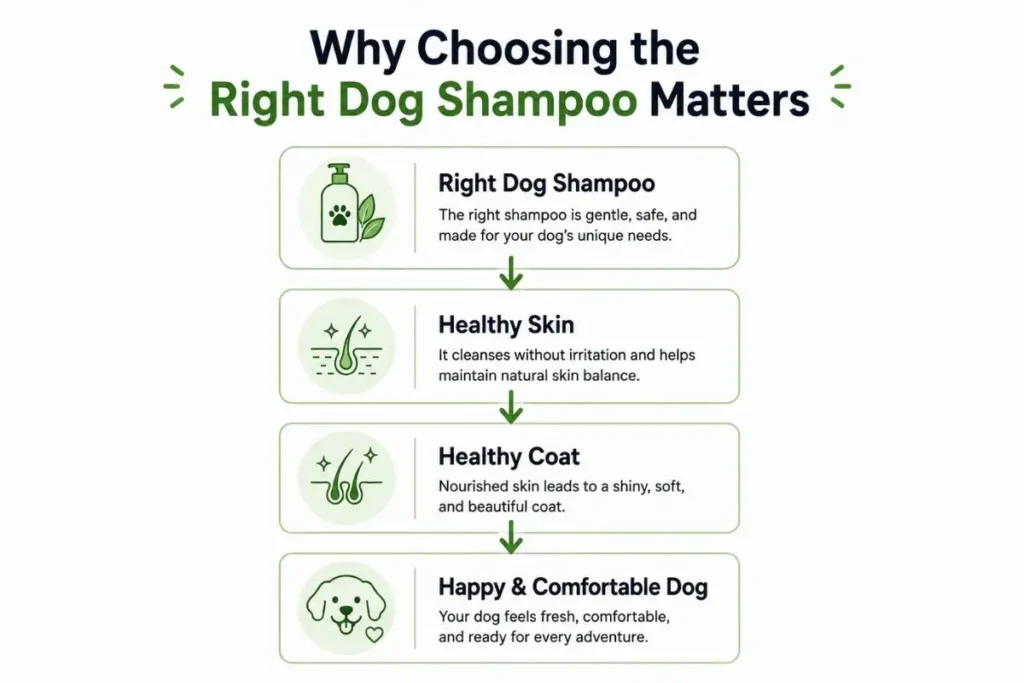
Many first-time dog owners choose a shampoo because it smells nice or has attractive packaging. In my experience, those details matter far less than your dog’s skin type, coat type, age, and grooming needs. A shampoo that works well for one dog may not be the right choice for another.
Healthy Skin Starts with the Right Shampoo
Every good grooming routine starts with healthy skin. Your dog’s skin acts as a natural protective barrier and has a different pH balance than human skin. A dog-specific shampoo is designed to clean the coat while helping support that natural balance and overall coat condition.
Why One Shampoo Doesn’t Work for Every Dog
There isn’t one dog shampoo that’s perfect for every dog. The right choice depends on several factors, including:
- Your dog’s skin type
- Coat type
- Age
- Lifestyle
- Grooming goals
For example, a Labrador with a short coat has different grooming needs than a Husky with a thick double coat or a Poodle with a curly coat. That’s why choosing a shampoo based only on the brand or price often leads to disappointment.
Common Problems Caused by Choosing the Wrong Shampoo
Using the wrong shampoo doesn’t always cause immediate problems. However, repeated use of an unsuitable formula may increase the risk of:
- Dry or flaky skin
- Mild skin irritation
- Frequent scratching
- A dull or unhealthy-looking coat
- Poor coat condition after bathing
These signs don’t always mean the shampoo is the only cause. Diet, allergies, parasites, seasonal changes, and underlying health conditions can also affect your dog’s skin and coat. If irritation, hair loss, or ongoing skin problems continue despite changing shampoos, consult your veterinarian to identify the underlying cause.
Experience Tip
One of the most common mistakes I’ve seen is owners choosing a shampoo based on the scent or the brand instead of their dog’s skin and coat needs. Taking a few minutes to evaluate your dog before buying usually leads to a much better choice.
Understand Your Dog Before Choosing a Shampoo
Before you compare shampoo brands or read product labels, take a few minutes to evaluate your dog. Understanding your dog’s skin, coat, age, lifestyle, and grooming needs makes choosing the right shampoo much easier. A few simple observations now can help you avoid buying a product that isn’t the best fit for your dog.
Check Your Dog’s Skin
Start by looking at your dog’s skin. Is it healthy, dry, sensitive, oily, or itchy? The condition of your dog’s skin is one of the biggest factors when choosing a shampoo. A gentle moisturizing formula may suit dry skin, while dogs with ongoing irritation may need a different approach.
Identify Your Dog’s Coat Type
Next, identify your dog’s coat type. Dogs with short, long, curly, or double coats all have different grooming needs. Coat type affects how dirt, oil, and loose hair build up, so it also influences which type of shampoo may be the most suitable.
For example, a Husky and a Beagle may both have healthy skin, but their coats are completely different. That difference alone can influence which shampoo category is the better choice.
If you’re unsure which brush works best for your dog’s coat, read our How to Choose the Right Dog Brush guide.
Consider Age and Lifestyle
A puppy, an active adult dog, and a senior dog don’t always have the same grooming needs. Lifestyle also matters. Dogs that swim often, spend more time outdoors, or need frequent baths may benefit from a different grooming routine than dogs that live mostly indoors.
Remember, breed alone shouldn’t determine your shampoo choice. Always consider your dog’s current skin condition, coat type, age, and daily lifestyle together.
Know Why You’re Bathing Your Dog
Finally, ask yourself one simple question:
Why does your dog need a bath today?
Your answer helps narrow down the right shampoo.
- Routine cleaning
- Dry or flaky skin
- Heavy shedding
- Unpleasant odor
- Flea or tick concerns
- Mud, dirt, or outdoor activity
Knowing the goal of the bath makes it much easier to choose a shampoo that matches your dog’s needs instead of relying on advertising or attractive packaging.
Quick Checklist
Before buying a dog shampoo, make sure you know:
- ✔ Your dog’s skin type
- ✔ Your dog’s coat type
- ✔ Your dog’s age
- ✔ Your dog’s lifestyle
- ✔ Why your dog needs a bath
Understand Your Dog’s Skin Type
Your dog’s skin tells you far more about the right shampoo than any product label ever will. Before comparing ingredients or choosing a brand, take a closer look at your dog’s skin. Identifying whether it’s healthy, dry, sensitive, oily, or itchy helps you choose a shampoo that matches your dog’s actual needs—not just a marketing claim.
Healthy Skin
Healthy skin is usually smooth, clean, and free from excessive redness, flakes, or irritation. A healthy coat often looks shiny, feels soft, and doesn’t have a strong odor between regular baths.
If your dog has healthy skin and no specific skin concerns, a gentle pH-balanced dog shampoo is often a good choice for routine grooming.
Dry Skin
Dry skin may appear flaky, dull, or rough. You might notice small white flakes in the coat or see your dog scratching more than usual after bathing.
Dry skin doesn’t always have a single cause. Weather changes, frequent bathing, low humidity, grooming habits, diet, or underlying health conditions can all play a role. For many dogs, a moisturizing or oatmeal-based shampoo may be a helpful option as part of a regular grooming routine.
Sensitive Skin
Dogs with sensitive skin may react more easily to certain ingredients, fragrances, or frequent bathing. Their skin may become red, irritated, or uncomfortable even after using products that work well for other dogs.
If your dog has sensitive skin, look for gentle, fragrance-free, or hypoallergenic formulas whenever possible. Dogs with ongoing irritation may also benefit from reading our Best Dog Shampoo for Sensitive Skin guide.
Itchy Skin
Occasional scratching is normal, but persistent itching deserves closer attention. Itching can be caused by many different factors, including allergies, parasites, dry skin, environmental triggers, or skin infections.
Many owners assume itching automatically means they need a medicated shampoo. In reality, shampoo is only one part of the picture. Finding the underlying cause is often more important than changing products.
If itching continues after changing shampoos or becomes more severe, read our Best Medicated Dog Shampoo for Itching guide and consider speaking with your veterinarian.
Oily Skin
Some dogs naturally produce more oil than others. An oily coat may feel greasy, attract dirt more quickly, and develop an unpleasant odor between baths.
In many cases, a dog-specific cleansing shampoo can help remove excess oil while maintaining the skin’s natural protective barrier. Avoid using harsh products that may strip too much oil, as this can sometimes make skin problems worse.
When Skin Problems Need Veterinary Attention
Routine grooming can help maintain healthy skin, but shampoo isn’t a treatment for every skin problem. If your dog develops persistent itching, open sores, hair loss, recurring skin infections, swelling, or signs of pain, it’s important to schedule a veterinary examination.
Many skin conditions have underlying causes that require a proper diagnosis and treatment plan. Choosing a different shampoo alone may not resolve the problem.
Skin Type Comparison Guide
| Skin Type | What You May Notice | Shampoo Consideration |
| Healthy | Smooth skin with no redness or flakes | Gentle pH-balanced maintenance formula |
| Dry | Flaky skin, dull coat, mild scratching | Moisturizing or oatmeal-based formula |
| Sensitive | Redness or irritation after grooming | Fragrance-free or hypoallergenic formula |
| Oily | Greasy coat and faster dirt buildup | Dog-specific cleansing formula |
| Itchy | Frequent scratching or licking | Identify the cause first; veterinary advice may be appropriate if symptoms persist |
Common Mistake
Many owners buy medicated shampoo as the first solution for itching. Before choosing a specialized product, try to identify why your dog is itchy. Allergies, parasites, grooming habits, and environmental factors can all contribute to skin irritation.
Experience Tip
One pattern I’ve noticed over the years is that owners often focus on stopping the itching instead of understanding what’s causing it. A better long-term approach is to evaluate your dog’s skin first, then choose a shampoo that matches its condition.
Understand Your Dog’s Coat Type Before Choosing a Shampoo
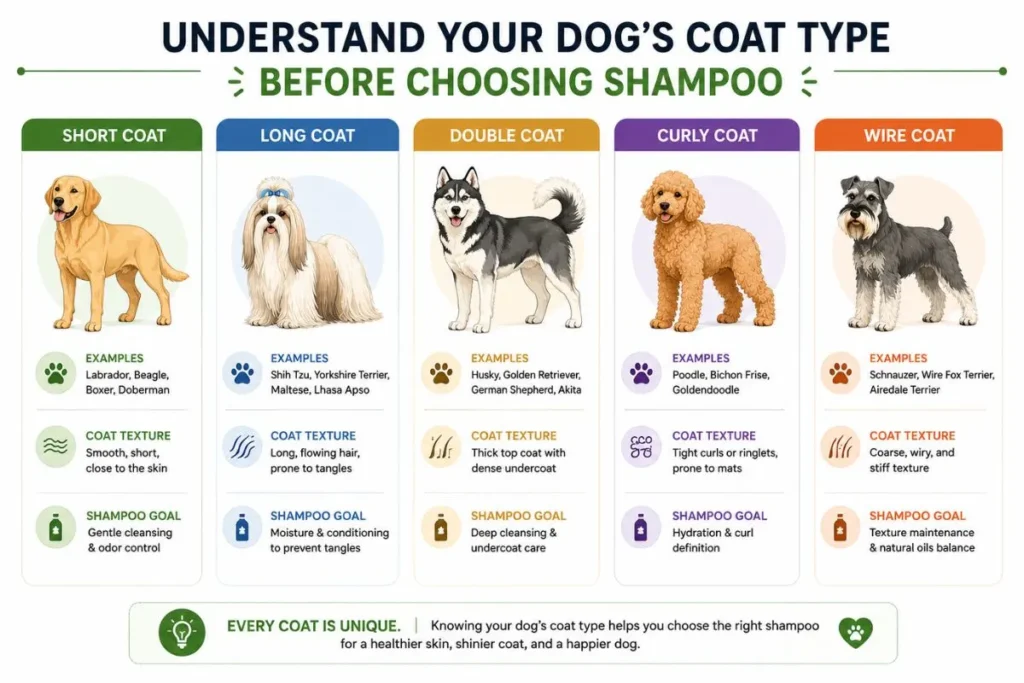
Two dogs can have equally healthy skin but need completely different shampoos because of their coat type. While skin condition is important, your dog’s coat also affects how dirt, oil, moisture, and loose hair build up. Understanding your dog’s coat is one of the easiest ways to choose a shampoo that fits their grooming needs.
Short Coat
Dogs with short coats, such as Labradors, Beagles, and Boxers, usually need simple coat maintenance. Their coats rarely develop heavy tangles, so a gentle maintenance shampoo is often enough to keep the coat clean and healthy.
Even though short-coated dogs are generally easier to groom, regular brushing still helps remove loose hair and distribute natural skin oils.
Long Coat
Long-coated breeds like Shih Tzus, Yorkshire Terriers, and Maltese need more moisture and coat conditioning. Their hair tangles more easily and may trap dirt between baths.
A moisturizing shampoo that supports coat softness can help keep the coat easier to brush and manage. Regular brushing is just as important as choosing the right shampoo.
Double Coat
Double-coated breeds, including Huskies, Golden Retrievers, and German Shepherds, have both a protective topcoat and a dense undercoat. These coats trap loose hair, dirt, and seasonal shedding much more easily than single coats.
Many owners think heavy shedding means they need a stronger shampoo. In my experience, brushing before bathing usually makes a bigger difference than changing shampoos. Removing loose undercoat first helps the shampoo reach the skin more effectively and can improve the overall grooming result.
If your dog has a double coat, choosing the right brush for double-coated dogs is just as important as choosing the right shampoo.
If shedding is your biggest concern, see our Best Dog Shampoo for Shedding Dogs guide.
Curly Coat
Curly-coated breeds such as Poodles and Goldendoodles often need extra moisture and gentle cleansing. Their coats can trap loose hair instead of letting it fall out naturally, making regular brushing and conditioning an important part of grooming.
Using a harsh shampoo may leave curly coats feeling dry and harder to manage.
Wire Coat
Wire-coated breeds have a rough outer coat that protects them from dirt and weather. These dogs usually benefit from gentle cleansing that preserves the coat’s natural texture rather than making it overly soft.
Always choose grooming products that match the needs of a wire coat instead of using formulas designed for completely different coat types.
Why Coat Type Matters
Your dog’s coat influences much more than appearance. It affects:
- How often your dog needs brushing
- How easily dirt builds up
- How much loose hair collects in the coat
- How moisture is retained
- Which shampoo type is likely to work best
Remember that coat type is only one part of the decision. Your dog’s skin condition is still the most important factor when choosing a shampoo.
Coat Type and Shampoo Guide
| Coat Type | Primary Grooming Need | Shampoo Goal |
| Short Coat | Routine maintenance | Gentle cleansing |
| Long Coat | Moisture and detangling | Moisturizing formula |
| Double Coat | Undercoat maintenance | Deep cleansing |
| Curly Coat | Hydration and coat care | Gentle moisturizing formula |
| Wire Coat | Texture maintenance | Mild cleansing |
One of the biggest misconceptions I see is that heavy shedding always means a stronger shampoo is needed. In many cases, improving the brushing routine has a much bigger impact than switching products.
Consider Your Dog’s Age, Lifestyle, and Grooming Needs
A shampoo that’s suitable for an active adult dog may not be the best choice for a young puppy or a senior dog with sensitive skin. As dogs grow and their daily routines change, their grooming needs can change too. Looking at your dog’s age, lifestyle, and bathing routine helps you choose a shampoo that fits their current needs—not just their breed.
Puppies
Puppies have delicate skin that is still developing, so they often benefit from gentle, dog-specific shampoos designed for young dogs. Many puppy shampoos are made with mild cleansing ingredients and tear-free formulas to make bath time more comfortable.
Adult Dogs
Healthy adult dogs usually need a shampoo that supports routine grooming and matches their skin and coat type. Whether your dog has a short, long, curly, or double coat, choosing a formula that fits their grooming needs is usually more important than choosing the most popular brand.
Senior Dogs
As dogs get older, their skin and coat may change. Some senior dogs develop drier skin or a coat that needs extra moisture. A gentle, moisturizing shampoo may help support skin comfort and coat condition as part of a regular grooming routine.
Indoor vs. Outdoor Dogs
Lifestyle also affects shampoo choice.
Dogs that spend most of their time indoors are often exposed to less dirt and debris than dogs that regularly hike, swim, play in mud, or spend long hours outside.
Outdoor dogs may need more frequent grooming because their coats collect dirt, grass, pollen, and loose debris more easily. However, frequent bathing should always be balanced with your dog’s skin condition and coat health.
Dogs That Need Frequent Baths
Some dogs naturally need baths more often than others. Examples include:
- Working dogs
- Dogs that swim regularly
- Outdoor and adventure dogs
- Dogs that become dirty during daily activities
Bathing more often doesn’t always mean using a stronger shampoo. In many cases, choosing a gentle formula designed for regular use is a better long-term approach.
Why Age and Lifestyle Matter
Many first-time owners use the same shampoo throughout their dog’s entire life. In my experience, that’s one of the most common grooming mistakes.
A puppy, an adult dog, and a senior dog often have different grooming needs. Lifestyle changes—such as swimming more often, spending more time outdoors, or becoming less active with age—can also influence which shampoo is the better choice.
Remember, age is only one part of the decision. Your dog’s skin condition and coat type should always come first when choosing a shampoo.
Types of Dog Shampoo Explained
Walk into any pet store, and you’ll find shelves full of dog shampoos that all promise great results. The challenge isn’t finding a shampoo—it’s knowing which type matches your dog’s needs. Every shampoo category is designed for a specific purpose, so understanding the differences helps you make a more confident decision.
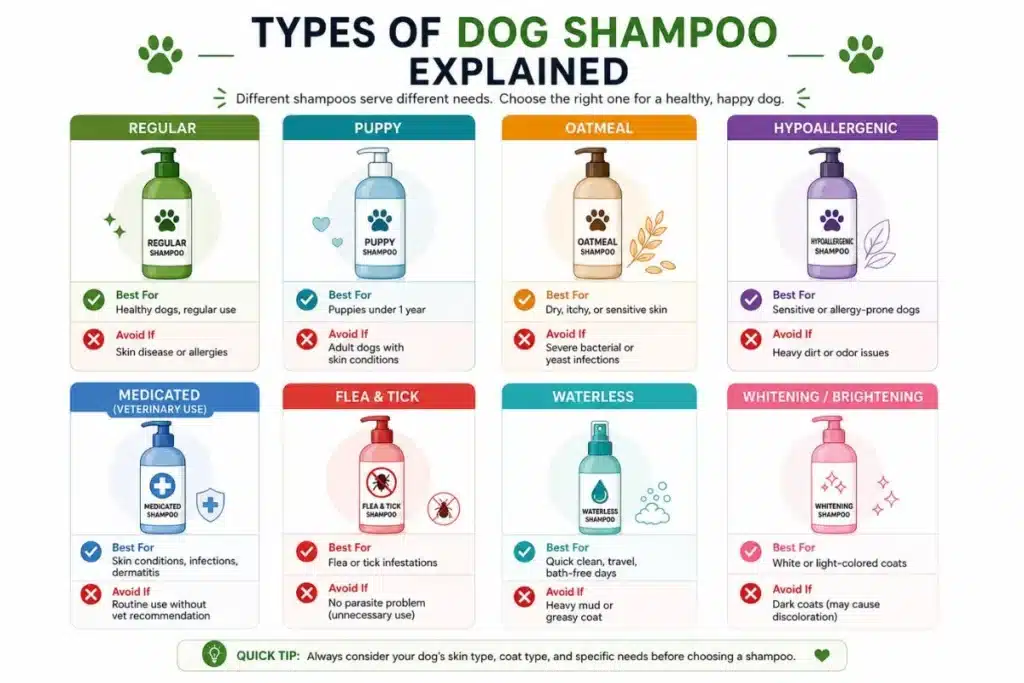
Remember, no single shampoo is better than all the others. The best choice depends on your dog’s skin condition, coat type, age, and grooming goals.
Regular Dog Shampoo
Purpose: Routine cleaning and coat maintenance.
Best For: Healthy dogs with no specific skin concerns.
Avoid When: Your dog has persistent itching, skin infections, or other medical skin conditions that require veterinary advice.
A gentle pH-balanced shampoo is often a good choice for routine bathing because it helps clean the coat without being unnecessarily harsh.
Puppy Shampoo
Purpose: Gentle cleansing for young dogs.
Best For: Puppies with delicate, developing skin.
Avoid When: An adult dog needs a shampoo designed for a specific skin condition.
Puppy shampoos are usually formulated to be mild and often include tear-free formulas to make bath time more comfortable.
Oatmeal Shampoo
Purpose: Support dry or mildly irritated skin.
Best For: Dogs with mild dryness or skin that benefits from extra moisture.
Avoid When: Your dog has an undiagnosed or severe skin condition that requires veterinary treatment.
Many oatmeal shampoos contain colloidal oatmeal, which is commonly used in gentle grooming products. While oatmeal can help support skin comfort, it isn’t a replacement for diagnosing the underlying cause of persistent skin problems.
Hypoallergenic Shampoo
Purpose: Reduce the likelihood of irritation from certain ingredients.
Best For: Dogs with sensitive skin or those that react easily to fragrances and dyes.
Avoid When: Your dog has an untreated medical skin condition that requires professional care.
Medicated Shampoo
Purpose: Help manage specific skin conditions under veterinary guidance.
Best For: Dogs with diagnosed skin problems when a veterinarian recommends a medicated formula.
Avoid When: You’re trying to treat unexplained itching or skin irritation on your own.
Many owners assume medicated shampoo is the answer to every skin problem. In reality, choosing the right treatment depends on identifying the underlying cause first.
Flea & Tick Shampoo
Purpose: Help manage fleas or ticks as part of a broader parasite-control plan.
Best For: Dogs with confirmed flea or tick problems.
Avoid When: Your dog doesn’t have fleas or ticks.
Flea shampoos are designed for a specific purpose. Using one when there isn’t a flea problem usually provides little benefit and may expose your dog to unnecessary active ingredients.
Whitening Shampoo
Purpose: Brighten light-colored coats and reduce the appearance of stains.
Best For: White or light-colored dogs that need cosmetic coat care.
Avoid When: You’re trying to solve skin irritation, itching, or shedding.
Whitening shampoos improve appearance, but they aren’t designed to treat skin or coat health issues.
Deodorizing Shampoo
Purpose: Reduce unpleasant coat odors.
Best For: Dogs with healthy skin that occasionally develop strong odors.
Avoid When: Persistent odor is accompanied by redness, discharge, or skin irritation.
A lingering odor may sometimes indicate an underlying skin or ear problem rather than a grooming issue.
Waterless Shampoo
Purpose: Freshen the coat between full baths.
Best For: Quick clean-ups, travel, or dogs that cannot have a full bath immediately.
Avoid When: Your dog is heavily soiled with mud, grease, or other debris.
Waterless shampoos are convenient, but they shouldn’t replace regular bathing when a full wash is needed.
If your dog can’t use a bathtub, see our How to Bathe a Dog Without a Bathtub guide.
Dog Shampoo Comparison Guide
| Shampoo Type | Best For | Avoid If |
| Regular | Healthy dogs | Ongoing medical skin problems |
| Puppy | Young puppies | Adult treatment needs |
| Oatmeal | Mild dryness | Severe or undiagnosed skin disease |
| Hypoallergenic | Sensitive skin | Diagnosed conditions needing medical treatment |
| Medicated | Certain diagnosed skin conditions | Routine use without veterinary guidance |
| Flea & Tick | Confirmed flea or tick problems | No parasite problem |
| Whitening | White or light-colored coats | Treating skin conditions |
| Deodorizing | Occasional coat odor | Persistent odor with skin problems |
| Waterless | Quick cleaning between baths | Heavy dirt or mud |
Common Mistake
Many owners buy flea shampoo simply because it’s available or heavily advertised. If your dog doesn’t have fleas or ticks, a flea shampoo usually isn’t the right choice.
Experience Tip
One lesson I’ve learned over the years is that most owners don’t need a “better” shampoo—they need the right type of shampoo. Choosing a product that matches your dog’s skin, coat, and grooming needs almost always leads to better results than choosing one based on marketing claims.
Ingredients to Look for in a Dog Shampoo
The ingredient list often tells you far more about a dog shampoo than the front label. Marketing claims like natural or premium can be helpful, but they don’t always explain how a shampoo supports your dog’s skin and coat. Learning what key ingredients do makes it much easier to choose a formula that fits your dog’s grooming needs.
Keep in mind that no single ingredient is perfect for every dog. The best choice depends on your dog’s skin condition, coat type, and the purpose of the bath.
Colloidal Oatmeal
Why it’s used: Helps support skin comfort and moisture.
Best for: Dogs with mild dryness or skin that benefits from extra hydration.
Colloidal oatmeal is one of the most common ingredients found in moisturizing dog shampoos. It helps support the skin’s natural moisture barrier and is often included in shampoos designed for dogs with dry or mildly irritated skin.
Aloe Vera
Why it’s used: Helps provide hydration and skin comfort.
Best for: Dogs with normal to mildly dry skin.
Aloe vera is commonly added to dog shampoos because of its moisturizing and soothing properties. However, not every shampoo contains the same amount or formulation, so ingredient quality can vary between products.
Glycerin
Why it’s used: Helps retain moisture.
Best for: Dry or dehydrated skin.
Glycerin is a humectant, which means it attracts and helps retain moisture. It is often included in moisturizing shampoos to help keep the skin and coat from becoming overly dry after bathing.
Ceramides
Why they’re used: Help support the skin’s natural barrier.
Best for: Dogs with sensitive or easily irritated skin.
Ceramides are natural lipids that help strengthen the skin barrier. Some grooming products include them to help support healthy skin, especially for dogs that are prone to dryness or sensitivity.
Mild Cleansing Agents
Why they’re used: Clean the coat without being unnecessarily harsh.
Best for: Routine bathing and regular grooming.
A gentle pH-balanced dog shampoo uses mild cleansing ingredients that remove dirt, excess oil, and debris while helping maintain the skin’s natural protective barrier. For most healthy dogs, this is a better long-term choice than using overly harsh cleansing formulas.
Why Ingredients Matter More Than Marketing
Many owners focus on the front of the bottle, where words like natural, premium, or extra strength are displayed. In my experience, the ingredient list usually provides a much clearer picture of what a shampoo is actually designed to do.
Instead of asking, Which brand is the best? ask:
- Does this formula match my dog’s skin condition?
- Does it support my dog’s coat type?
- Does it solve the problem I’m trying to address?
Those questions usually lead to a better decision than marketing claims alone.
If your dog has sensitive skin, our Best Dog Shampoo for Sensitive Skin guide explains which ingredients are often worth looking for.
Ingredient Guide
| Ingredient | Why It’s Used | Often Best For |
| Colloidal Oatmeal | Supports skin comfort and moisture | Mild dryness |
| Aloe Vera | Hydration and soothing support | Normal to dry skin |
| Glycerin | Moisture retention | Dry skin |
| Ceramides | Supports the skin barrier | Sensitive skin |
| Mild Cleansing Agents | Gentle cleaning | Routine grooming |
Veterinary Note
An ingredient isn’t automatically good or bad. How well it works depends on your dog’s skin condition, the overall formulation, and how the shampoo is used. If your dog has persistent skin problems, consult your veterinarian rather than relying on a single ingredient to solve the issue.
Ingredients and Claims to Evaluate Carefully
The front of a dog shampoo bottle often highlights words like natural, organic, or hypoallergenic. While these claims can provide useful information, they don’t always tell the whole story. Understanding what these terms usually mean helps you choose a shampoo based on facts rather than marketing.
No single label claim guarantees that a shampoo will be the right choice for every dog. Always consider the complete ingredient list, your dog’s skin condition, and the purpose of the shampoo.
Fragrance
Some dogs tolerate scented shampoos without any problems, while others may have more sensitive skin. If your dog has a history of skin irritation or reacts easily to grooming products, a fragrance-free formula may be worth considering.
The goal isn’t to avoid every scented shampoo—it’s to choose a product that matches your dog’s individual needs.
Alcohol
Seeing the word alcohol on an ingredient list can be confusing. Not all alcohols serve the same purpose.
Some alcohols are used as solvents or preservatives, while others help improve the texture and stability of the product. Reading the complete ingredient list is more helpful than judging a shampoo based on one ingredient alone.
Artificial Colors
Artificial colors are mainly added to improve the appearance of the shampoo rather than its grooming performance.
While many dogs use products containing colorants without problems, dogs with sensitive skin may benefit from simpler formulas with fewer unnecessary additives.
Sulfates
Sulfates are cleansing ingredients that help remove dirt, oil, and debris.
Some shampoos use stronger cleansing agents than others. Dogs with healthy skin may tolerate them well, while dogs with dry or sensitive skin sometimes benefit from gentler cleansing formulas.
Instead of asking whether sulfates are good or bad, consider whether the overall formula matches your dog’s skin condition.
Natural
The word natural is one of the most common marketing terms found on dog shampoo bottles.
In many cases, it simply means that some ingredients are naturally derived. It doesn’t automatically mean the shampoo is safer, gentler, or better suited for your dog.
Always look beyond the marketing claim and review the complete ingredient list.
Organic
Organic is different from “natural.”
This term usually refers to specific ingredients or production standards rather than the overall performance of the shampoo.
An organic shampoo isn’t automatically the best option for every dog. The right choice still depends on your dog’s skin, coat, and grooming needs.
Hypoallergenic
The term hypoallergenic generally means the product is formulated to reduce the likelihood of irritation by avoiding certain ingredients that commonly trigger reactions.
However, no shampoo can guarantee that every dog will respond the same way, because individual sensitivities vary.
Common Mistake
Many first-time owners buy a shampoo simply because the bottle says Natural. A marketing claim alone doesn’t tell you whether the formula matches your dog’s skin and coat.
Trust Note
No single ingredient or marketing claim determines whether a shampoo is right for your dog. The best choice always depends on your dog’s skin condition, coat type, grooming needs, and the overall product formulation.
Common Dog Shampoo Buying Mistakes
Most dog shampoo problems don’t happen because owners buy a low-quality product. They happen because the shampoo doesn’t match the dog’s skin condition, coat type, or grooming needs. Avoiding a few common mistakes can save you money and help keep your dog’s skin and coat healthier over time.
Buying Based on the Brand Alone
A well-known brand doesn’t automatically mean it’s the right shampoo for your dog. Every formula is designed for a different purpose, so it’s more important to match the shampoo to your dog’s needs than to choose the most popular product.
Ignoring Your Dog’s Skin Type
Many owners focus on the coat and forget to evaluate the skin first. However, your dog’s skin should always guide your shampoo choice.
For example, a dog with dry skin may benefit from a moisturizing formula, while a dog with sensitive skin may do better with a fragrance-free or hypoallergenic shampoo.
Ignoring Your Dog’s Coat Type
Coat type affects how dirt, oil, and loose hair build up. A shampoo that works well for a short-coated dog may not be the best choice for a dog with a thick double coat or a curly coat.
Always consider both the skin and the coat before choosing a shampoo.
Buying Only by Price
An expensive shampoo isn’t always better, and the cheapest option isn’t always the best value.
Instead of comparing prices first, compare the ingredients, shampoo type, and intended purpose. Choosing the right formula often matters more than the price tag.
Not Reading the Ingredient List
Many people only read the front of the bottle.
The ingredient list usually provides much more useful information about what the shampoo is designed to do. Looking for ingredients that match your dog’s needs is often a better strategy than relying on marketing claims.
Choosing a Medicated Shampoo Too Quickly
Medicated shampoos can be helpful in certain situations, but they aren’t the right solution for every dog.
Persistent itching, redness, or skin irritation can have many possible causes. Before choosing a medicated product, try to understand why the problem is happening. If symptoms continue, consult your veterinarian for a proper diagnosis.
Expecting Instant Results
A shampoo rarely transforms your dog’s coat after a single bath.
Healthy skin and coat condition usually improve gradually as part of a consistent grooming routine that includes appropriate bathing, brushing, and overall care.
Before You Buy a Dog Shampoo
Take a minute to confirm that you’ve:
- Checked your dog’s skin condition
- Identified your dog’s coat type
- Read the ingredient list
- Decided why your dog needs a bath
- Chosen the correct shampoo category
Experience Insight
One of the most common patterns I’ve noticed is owners replacing a shampoo after only one bath because they expected immediate results. In many cases, the shampoo isn’t the problem. A healthy coat develops gradually through a consistent grooming routine that includes regular brushing, proper bathing, and choosing a formula that matches your dog’s needs.
Trust Note
Switching to a different shampoo isn’t always the answer. If your dog continues to experience persistent itching, redness, hair loss, or other skin problems despite appropriate grooming, consult your veterinarian to identify the underlying cause.
You’ve learned what to avoid. Now let’s put everything together and walk through a simple step-by-step framework to choose the right dog shampoo with confidence.
How to Choose the Right Dog Shampoo: A Simple Step-by-Step Framework
After learning about skin types, coat types, ingredients, and common shopping mistakes, it’s time to put everything together. Choosing the right dog shampoo becomes much easier when you follow a simple decision process instead of relying on marketing claims or brand popularity.
Work through these six steps before you buy your next dog shampoo.
Step 1: Check Your Dog’s Skin
Start by evaluating your dog’s skin. Ask yourself:
- Is the skin healthy?
- Is it dry or flaky?
- Does your dog have sensitive skin?
- Is your dog scratching frequently?
- Does the coat feel oily?
Your dog’s skin condition should always be your starting point because it has the biggest influence on shampoo selection.
Step 2: Identify Your Dog’s Coat Type
Next, identify your dog’s coat type.
Is your dog:
- Short-coated?
- Long-coated?
- Double-coated?
- Curly-coated?
Different coat types have different grooming needs. Understanding the coat helps you choose a shampoo that supports healthy coat maintenance instead of simply cleaning the surface.
Step 3: Consider Your Dog’s Age
Age also influences grooming needs.
Think about whether your dog is:
- A puppy
- An adult dog
- A senior dog
Puppies often benefit from gentler formulas, while some senior dogs may need extra skin and coat support as they age.
Step 4: Identify Your Main Grooming Goal
Now ask yourself one simple question:
Why are you bathing your dog today?
Your answer helps narrow down the right shampoo category.
Common goals include:
- Routine cleaning
- Dry skin support
- Heavy shedding
- Flea or tick concerns
- Reducing unpleasant odors
Choosing a shampoo based on your grooming goal is much more effective than choosing one based on advertising.
Step 5: Read the Ingredient List
Before adding a shampoo to your cart, turn the bottle over and read the ingredient list.
Look for ingredients that match your dog’s needs, such as:
- Colloidal oatmeal for skin comfort
- Glycerin for moisture retention
- Ceramides to support the skin barrier
The ingredient list usually tells you far more than the marketing claims on the front label.
Step 6: Perform a Small Patch Test
Whenever you’re using a new shampoo, perform a simple patch test first.
Apply a small amount during the first bath and watch your dog’s skin over the next 24 hours for any unusual redness, irritation, or discomfort.
Most dogs tolerate new shampoos without any problems, but checking for an individual reaction is a simple precaution that can give you extra confidence.
If irritation continues after trying an appropriate shampoo, seek professional veterinary care to identify the underlying cause rather than repeatedly changing shampoos.
Your Dog Shampoo Decision Flow
- ✔ Check your dog’s skin.
- ✔ Identify the coat type.
- ✔ Consider your dog’s age.
- ✔ Decide why your dog needs a bath.
- ✔ Read the ingredient list.
- ✔ Perform a patch test before regular use.
Following these steps helps you choose a shampoo based on your dog’s individual needs instead of marketing claims or brand popularity.
Experience Tip
One pattern I’ve noticed over the years is that many first-time owners start by comparing shampoo brands. Experienced owners usually start by evaluating the dog first. That small change in the decision process often leads to a much better shampoo choice.
Trust Note
Even the right shampoo cannot solve every skin problem. Persistent itching, redness, hair loss, recurring skin infections, or ongoing discomfort may be caused by allergies, parasites, infections, or other medical conditions that require veterinary care.
Quick Dog Shampoo Buying Checklist
If you’re standing in a pet store or shopping online, you don’t need to remember everything you’ve learned in this guide. Simply use this quick checklist before buying a dog shampoo. It takes less than a minute and can help you avoid the most common buying mistakes.
Dog Shampoo Buying Checklist
Before adding a shampoo to your cart, ask yourself:
- ☐ Is this shampoo made specifically for dogs?
- ☐ Does it match my dog’s skin condition?
- ☐ Does it match my dog’s coat type?
- ☐ Is it suitable for my dog’s age?
- ☐ Does it solve the main reason I’m bathing my dog?
- ☐ Have I checked the key ingredients?
- ☐ Have I read the usage instructions on the label?
- ☐ Will I perform a small patch test before regular use?
If you answered Yes to every question, you’re much more likely to choose a shampoo that fits your dog’s individual needs.
Common Questions About Choosing a Dog Shampoo
These are some of the most common questions dog owners ask before buying a new shampoo. If you still have questions after reading this guide, the answers below should help you make a more confident decision.
1. How do I choose the right dog shampoo?
Choose a shampoo based on your dog’s skin condition, coat type, age, and grooming needs rather than the brand or marketing claims.
Start by evaluating your dog’s skin, then consider the coat type, age, and the reason for the bath. Finally, read the ingredient list and choose a formula that matches those needs.
2. Can I use human shampoo on dogs?
No. Human shampoo isn’t formulated for a dog’s skin and may not be the best choice for regular grooming.
Dogs have different skin characteristics than people, so using a dog-specific shampoo is generally the better option for routine bathing.
3. Which shampoo is best for puppies?
Puppies usually benefit from a gentle, dog-specific shampoo made for young dogs.
Look for mild formulas that support delicate skin. A product designed for adult dogs may not always be the best choice for a puppy.
4. How often should I shampoo my dog?
It depends on your dog’s skin, coat, lifestyle, and grooming needs.
Dogs that swim often or spend a lot of time outdoors may need more frequent baths than indoor dogs. Bathing too often or too rarely can both affect coat condition.
5. Is oatmeal shampoo good for dogs?
Oatmeal shampoo can be a good option for many dogs with mild dryness or skin that benefits from extra moisture.
Many formulas contain colloidal oatmeal, which is commonly used to support skin comfort. However, persistent skin problems should be evaluated by a veterinarian instead of relying on shampoo alone.
6. When do dogs need medicated shampoo?
A medicated shampoo is usually recommended after a veterinarian has diagnosed the underlying skin condition, rather than as the first solution for every itchy dog.
They aren’t intended for every itchy dog. Persistent itching can have many different causes, including allergies, parasites, infections, or other health conditions.
7. Can I switch dog shampoo brands?
Yes. If your dog’s grooming needs change or a different formula is a better fit, you can switch shampoos.
Introduce the new product gradually and monitor your dog’s skin after the first few baths to make sure it remains comfortable.
8. What if my dog scratches after using a shampoo?
Occasional scratching isn’t always a sign of a problem, but persistent irritation shouldn’t be ignored.
Stop using the product if you notice unusual redness, swelling, or ongoing discomfort. If symptoms continue or become worse, consult your veterinarian to identify the underlying cause.
Experience Tip
Many grooming questions don’t have one “perfect” answer because every dog is different. The best results usually come from understanding your dog’s skin and coat first, then choosing products that match those needs.
Trust Note
This guide is designed to help you make informed grooming decisions. It isn’t a substitute for veterinary advice. If your dog develops persistent itching, hair loss, skin infections, or other ongoing skin problems, seek professional veterinary care.
Choosing the Right Dog Shampoo: Key Takeaways
Choosing the right dog shampoo doesn’t have to be complicated. The best choice starts with understanding your dog’s skin condition, coat type, age, and grooming needs—not the brand or marketing claims on the bottle.
Before buying a shampoo, take a few minutes to evaluate your dog, identify your grooming goal, and check the ingredient list. This simple approach can help you avoid common mistakes and choose a product that’s a better fit for your dog’s individual needs.
Over the years, I’ve found that owners who understand their dog’s skin and coat usually make better grooming decisions than those who simply buy the most popular shampoo.
Remember, every dog is different. If your dog develops persistent itching, redness, hair loss, or other ongoing skin problems, consult your veterinarian to identify the underlying cause.
Don’t choose a shampoo first. Understand your dog first—then choose the shampoo that matches your dog’s needs.
Continue Your Dog Grooming Journey
Start with our complete beginner’s guide to learn the essential grooming skills every dog owner should know. Dog Grooming for Beginners