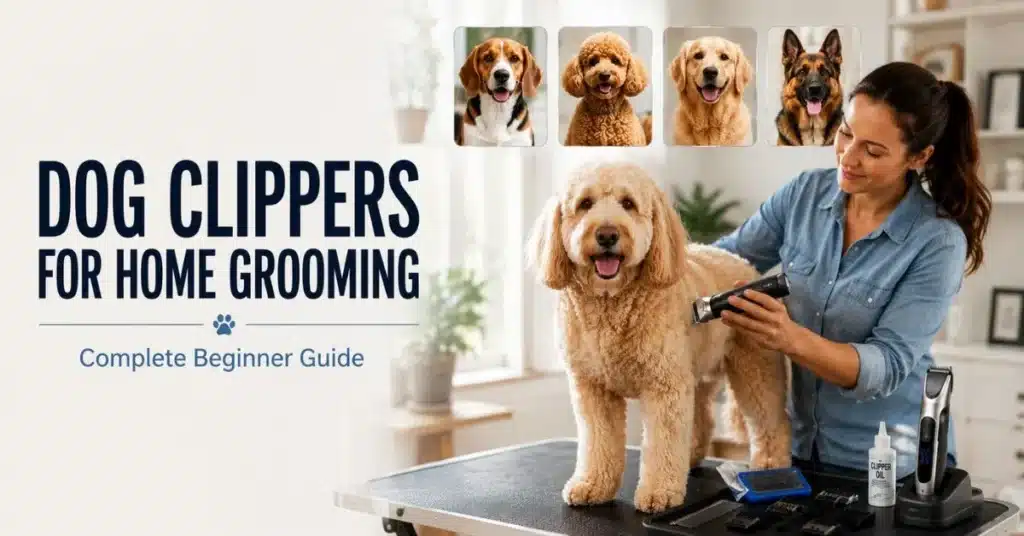
Dog clippers for home grooming are specialized grooming tools designed to safely trim and maintain a dog’s coat at home. The right clipper depends on your dog’s coat type, grooming needs, and experience level. Choosing the right tool can make grooming safer, easier, and more comfortable for both you and your dog.
In this beginner-friendly guide, you’ll learn how to choose the right dog clippers, understand the different types available, match clippers to different coat types, and avoid common mistakes such as hair pulling, overheating, and uneven cuts.
What Are Dog Clippers?
Many first-time dog owners assume that all clippers work the same. However, dog clippers are specifically designed to handle different coat types and grooming needs, making them a better choice for home grooming than standard human hair clippers.
Dog clippers are electric grooming tools used to trim and maintain a dog’s coat safely and efficiently. Unlike human hair clippers, they are built to work with a variety of coat textures, including thick coats, double coats, curly coats, and dense fur that can quickly clog ordinary clippers.
Most dog clippers include a powerful motor, removable clipper blades, and optional guide combs that help control cutting length. Depending on the model, they may be corded or cordless and can be used for everything from light coat maintenance to full-body grooming.
How Dog Clippers Work
Dog clippers use a moving blade system that cuts hair as it passes between two sharpened metal edges. The motor powers the blades, allowing them to trim large amounts of fur efficiently during grooming sessions.
Several factors influence clipping performance:
- Blade quality
- Motor power
- Blade sharpness
- Coat thickness
- Battery life (for cordless models)
- Noise level
For example, a clipper that works well on a short-haired dog may struggle with a Golden Retriever, German Shepherd, or heavily coated Goldendoodle, all of which require more cutting power.
Dog Clippers vs Human Hair Clippers
One of the most common beginner mistakes is assuming that human hair clippers can be used on dogs.
While they may look similar, dog clippers are specifically engineered for animal coats, which are often denser and more challenging to trim than human hair. Human hair clippers may:
- Pull or snag dog hair
- Overheat quickly
- Struggle with thick or curly coats
- Create an uncomfortable grooming experience
Dog clippers, on the other hand, are designed to work with different coat types while reducing hair pulling and improving grooming efficiency.
If you’re unsure whether a clipper or trimmer is the better option for your grooming routine, check out our guide on Dog Clippers vs Trimmers for Home Grooming, where we compare their uses, advantages, and ideal grooming situations.
Common Beginner Mistake
Many first-time dog owners try to groom their dog using human hair clippers. This often leads to hair pulling, overheating, and uneven trimming, especially on thick, curly, or matted coats.
Benefits of Using Dog Clippers at Home
More dog owners are turning to home dog grooming because it offers greater flexibility, convenience, and control over their dog’s grooming routine. While professional groomers provide valuable services, having a quality set of dog clippers can make routine coat maintenance easier throughout the year.
Save Money on Grooming Costs
Professional grooming appointments can become expensive over time, especially for breeds that require regular coat maintenance.
Home grooming can help reduce costs by allowing owners to handle:
- Basic trims
- Touch-up grooming
- Paw and sanitary area maintenance
- Routine coat maintenance between grooming appointments
Although quality dog clippers require an initial investment, they can help reduce long-term grooming expenses for many dog owners.
Groom on Your Own Schedule
One of the biggest advantages of grooming your dog at home is convenience.
Instead of scheduling appointments and traveling to a grooming salon, you can groom your dog whenever it fits your routine.
This is particularly helpful for:
- Busy households
- Multi-dog homes
- Dogs that require frequent trimming
- Dogs that become stressed during travel
Better Grooming Control
Home grooming gives you greater control over your dog’s coat care and grooming experience.
You can:
- Focus on specific problem areas
- Work at your dog’s pace
- Take breaks when needed
- Maintain a consistent grooming routine
This level of control is often helpful for puppies, senior dogs, and dogs that are still learning to accept grooming.
Reduce Stress for Nervous Dogs
Some dogs become anxious in unfamiliar environments or around other animals.
Home grooming allows dogs to remain in a familiar setting where they often feel more comfortable and relaxed.
Many owners find that shorter grooming sessions at home are less stressful than lengthy salon appointments.
Experience Tip
Dogs that are sensitive to sound often respond better when clippers are introduced gradually. Letting your dog hear the clipper before grooming can make future grooming sessions easier and less stressful.
Maintain a Healthier Coat
For long-haired breeds, consistent coat maintenance can also make daily brushing easier and more effective. According to the AVMA, routine grooming and coat care play an important role in maintaining a dog’s overall health and comfort.
Routine clipping can help:
- Reduce tangles
- Prevent matting
- Improve coat appearance
- Support overall grooming hygiene
For long-haired breeds, consistent coat maintenance can also make daily brushing easier and more effective.
If you’re building a complete at-home grooming routine, check out our Daily Dog Care Routine guide for additional tips on brushing, hygiene, exercise, and everyday dog care.
Types of Dog Clippers
Not all dog clippers are designed for the same grooming needs. Some models prioritize power, while others focus on portability and ease of use. Understanding the main types of dog clippers can help you choose the right option based on your dog’s coat type, grooming frequency, and experience level.
Corded Dog Clippers
Corded dog clippers plug directly into an electrical outlet and provide continuous power throughout the grooming session.
Advantages
- Consistent power output
- Suitable for thick and dense coats
- No battery limitations
- Ideal for longer grooming sessions
Limitations
- Reduced mobility
- Power cord can get in the way
- Less convenient for outdoor grooming
Corded clippers are often preferred by owners who groom large dogs, thick-coated breeds, or multiple dogs regularly.
Cordless Dog Clippers
Cordless dog clippers use rechargeable batteries and offer greater flexibility during grooming.
These models are especially popular among beginners because they are lightweight and easy to maneuver.
Advantages
- Greater mobility
- Easier handling
- Beginner-friendly
- No power cord restrictions
Limitations
- Limited battery life
- May require recharging during longer sessions
- Some models offer less motor power than corded alternatives
Modern cordless clippers have improved significantly and can be an excellent choice for routine home grooming and touch-up trims.
Professional Dog Clippers
Professional dog clippers are designed for frequent use and challenging coat types.
They typically feature:
- More powerful motors
- Higher durability
- Advanced blade systems
- Better performance on thick, curly, or matted coats
Although they tend to cost more, professional-grade clippers may be worth considering if you groom regularly or own breeds with demanding grooming requirements.
Corded vs Cordless Dog Clippers Comparison
| Feature | Corded Clippers | Cordless Clippers |
| Power | Consistent | Varies by battery |
| Mobility | Lower | Higher |
| Battery Life | Unlimited | Limited |
| Beginner-Friendly | Moderate | High |
| Thick Coats | Excellent | Good to Excellent |
| Long Grooming Sessions | Excellent | Depends on battery |
Which Type Is Best for Beginners?
For most first-time dog owners, cordless dog clippers are often the easiest starting point because they offer better mobility and are generally easier to handle.
However, if your dog has a thick coat, double coat, or requires frequent grooming, a corded or professional-grade clipper may provide more consistent performance.
How to Choose the Right Dog Clippers
The best dog clipper is not necessarily the most expensive one. The right choice depends on your dog’s coat type, grooming needs, and experience level. Understanding a few key factors before buying can help you avoid common mistakes and choose a clipper that performs well for your specific situation.
Consider Your Dog’s Coat Type
Your dog’s coat type should be the first factor you evaluate.
Different coats require different levels of cutting power and blade performance.
For example:
- Short coats often require basic maintenance clippers.
- Curly coats typically benefit from stronger motors and quality blades.
- Double coats may require heavy-duty grooming equipment.
- Matted coats often need more powerful clippers and additional grooming preparation.
Many grooming problems occur because owners choose clippers that are not designed for their dog’s coat.
Check Blade Quality
The quality of the clipper blades has a major impact on grooming performance.
Look for:
- Durable blade materials
- Replaceable blades
- Easy cleaning
- Smooth cutting performance
Sharp, well-maintained blades help reduce hair pulling and create a more comfortable grooming experience.
Consider Noise Level
Some dogs are highly sensitive to sound and vibration.
A quieter clipper may help reduce anxiety and make grooming sessions easier, especially for puppies or nervous dogs.
If your dog becomes stressed around grooming equipment, noise level should be one of your top priorities.
For sensitive dogs, you may also want to compare some of the Best Quiet Dog Clippers for Anxious Dogs.
Corded or Cordless?
Ask yourself:
- How often will you groom?
- How long are your grooming sessions?
- Does your dog have a thick coat?
- Do you prefer maximum power or greater mobility?
For many beginners, cordless dog clippers are easier to handle and more convenient. However, corded dog clippers often provide more consistent power for demanding grooming tasks.
If you’re still deciding between the two, our comparison of Corded vs Cordless Dog Clippers explains the pros and cons of each option.
Think About Maintenance
Every clipper requires routine maintenance to perform well over time.
Before purchasing, consider:
- Blade cleaning requirements
- Replacement blade availability
- Lubrication needs
- Long-term maintenance costs
A clipper that is easy to maintain is usually easier to keep operating smoothly and safely.
You can also learn more in our guide on How to Clean and Maintain Dog Clippers.
What First-Time Groomers Often Overlook
Many beginners focus primarily on price and ignore factors such as coat compatibility, blade quality, noise level, and maintenance requirements. In practice, these features often have a much greater impact on grooming success than the purchase price alone.
Choose the Right Dog Clippers for Your Dog’s Coat Type
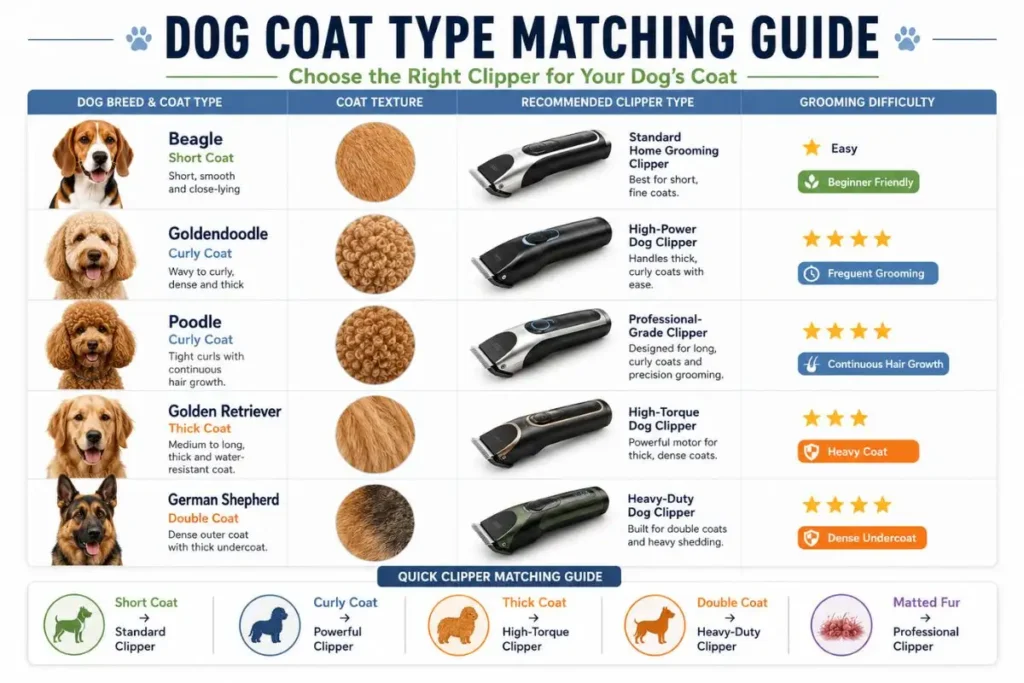
Choosing the right dog clipper starts with understanding your dog’s coat type. One of the biggest reasons home grooming becomes frustrating is that many owners buy clippers without considering how their dog’s coat behaves during trimming.
A clipper that works well on a short-haired dog may struggle with thick coats, curly coats, double coats, or heavily matted fur. Matching the clipper to your dog’s coat can improve grooming results, reduce hair pulling, and create a more comfortable grooming experience.
Why Coat Type Matters
Different coat types place different demands on clipper blades and motors.
Factors that affect clipper performance include:
- Hair density
- Coat thickness
- Curl pattern
- Matting tendency
- Shedding level
- Grooming frequency
Dogs with dense or challenging coats often require more powerful clipping systems than dogs with short, smooth coats.
Coat Type Matching Table
| Coat Type | Common Breeds | Recommended Clipper Type |
| Short Coat | Beagle, Boxer, Labrador | Standard home grooming clipper |
| Medium Coat | Border Collie, Spaniel | Mid-range clipper with guide combs |
| Curly Coat | Poodle, Goldendoodle | Powerful clipper with quality blades |
| Thick Coat | Golden Retriever, Husky | High-torque clipper |
| Double Coat | German Shepherd, Akita | Heavy-duty clipper |
| Matted Coat | Long-haired breeds with tangles | Professional-grade clipper with careful preparation |
Short Coats
Dogs with short coats typically require minimal clipping.
Examples include:
- Beagle
- Boxer
- Doberman
- Labrador Retriever
In many cases, occasional touch-up grooming and routine brushing are sufficient. Most owners can comfortably manage these coats using beginner-friendly dog clippers.
Curly Coats
Curly coats often require more frequent grooming because the hair grows continuously and can become tangled over time.
Common examples include:
- Poodle
- Goldendoodle
- Labradoodle
These breeds often benefit from:
- Strong motors
- Sharp blades
- Reliable guide combs
Many lightweight beginner clippers struggle with dense curly coats.
Thick and Double Coats
Thick-coated and double-coated breeds can be more demanding during grooming.
Examples include:
- Golden Retriever
- Siberian Husky
- German Shepherd
- Akita
These coats often require:
- More powerful motors
- Durable blades
- Longer grooming sessions
A weak clipper may pull hair instead of cutting smoothly.
Experience Tip
Many owners assume thick coats simply need sharper blades. In practice, motor strength often plays a bigger role than blade sharpness when grooming dense fur.
If your dog has a dense coat, our guide to Best Dog Clippers for Thick Hair can help you compare suitable options.
Matted Coats
Matted fur requires extra care and preparation.
Heavy mats can:
- Trap dirt and moisture
- Pull on the skin
- Make clipping uncomfortable
- Increase the risk of uneven trimming
Before clipping a heavily matted coat:
- Assess the severity of the mats.
- Brush out loose tangles when possible.
- Work slowly around sensitive areas.
- Avoid forcing the clipper through dense mats.
Severe matting may require professional grooming assistance.
For more recommendations, see our guide to Best Dog Clippers for Matted Hair.
Quick Decision Guide
If your dog has:
- Short coat → Standard home grooming clipper
- Curly coat → High-performance clipper
- Thick coat → Heavy-duty clipper
- Matted fur → Professional-grade clipper
- Noise sensitivity → Quiet clipper model
If your dog becomes anxious during grooming, you may also benefit from our guide to Best Quiet Dog Clippers for Anxious Dogs.
Dog Clipper Blade Size
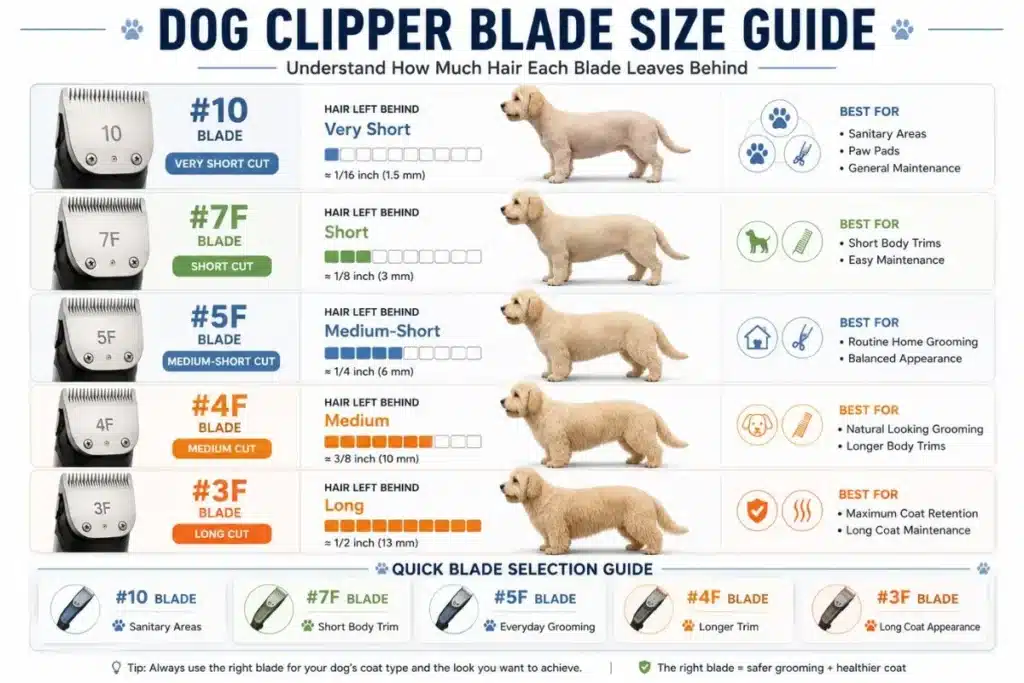
Blade sizes are one of the most confusing topics for beginner groomers. Many first-time dog owners assume that larger blade numbers leave more hair behind. In reality, dog clipper blade sizes often work the opposite way.
Generally, higher blade numbers leave shorter hair.
Understanding blade sizes can help you choose the right grooming length, avoid cutting too much coat, and achieve more consistent grooming results.
Why Blade Size Matters
The blade size you choose affects:
- Hair length after grooming
- Overall coat appearance
- Grooming precision
- Comfort during clipping
- Safety around sensitive areas
Using the wrong blade may result in uneven trimming or a shorter cut than expected.
Dog Clipper Blade Size Chart
| Blade Size | Typical Use | Hair Left Behind |
| #10 | General grooming, sanitary areas | Very short |
| #7F | Short body trims | Short |
| #5F | Medium body trims | Medium-short |
| #4F | Longer trims | Medium |
| #3F | Longer coat maintenance | Longer |
Most Common Blade for Beginners
The #10 blade is one of the most commonly used dog grooming blades.
It is frequently used for:
- Sanitary trimming
- Paw areas
- Basic maintenance
- Sensitive grooming areas
However, it is not always the best choice for full-body grooming, especially if you want to leave more coat length.
Understanding “F” Blades
You may notice blade sizes such as:
- #7F
- #5F
- #4F
The “F” stands for Finish Cut.
These blades are designed to create a smoother and more uniform finish compared to skip-tooth blades, making them popular for routine home grooming.
Matching Blade Size to Coat Type
While blade size is important, coat type should always be considered as well.
For example:
- A Poodle may require a different blade choice than a Golden Retriever
- Dense coats often need stronger clipping systems
- Matted coats may require special preparation before trimming
If you’re still unsure which clipper works best for your dog’s coat, see our Coat Type Matching Guide above.
Common Blade Size Mistakes
Using a Short Blade Too Early
Many beginners start with a very short blade and remove more coat than intended.
Ignoring Coat Type
A blade that works well on one breed may not be ideal for another.
Skipping a Test Area
Before grooming the entire coat, test a small section first to confirm the cutting length and appearance.
Common Beginner Confusion
Dog clipper blade numbers do not work like traditional hair clipper guard numbers. Always verify the expected cutting length before starting.
Blade Safety Reminder
Always monitor blade temperature during grooming.
Hot blades may:
- Cause discomfort
- Irritate the skin
- Increase grooming stress
A simple habit is to check blade warmth every few minutes during longer grooming sessions.
Quick Tip
If you’re new to home grooming, it’s usually safer to start with a longer blade or guide comb. You can always remove more hair later, but you cannot put it back once it’s been clipped.
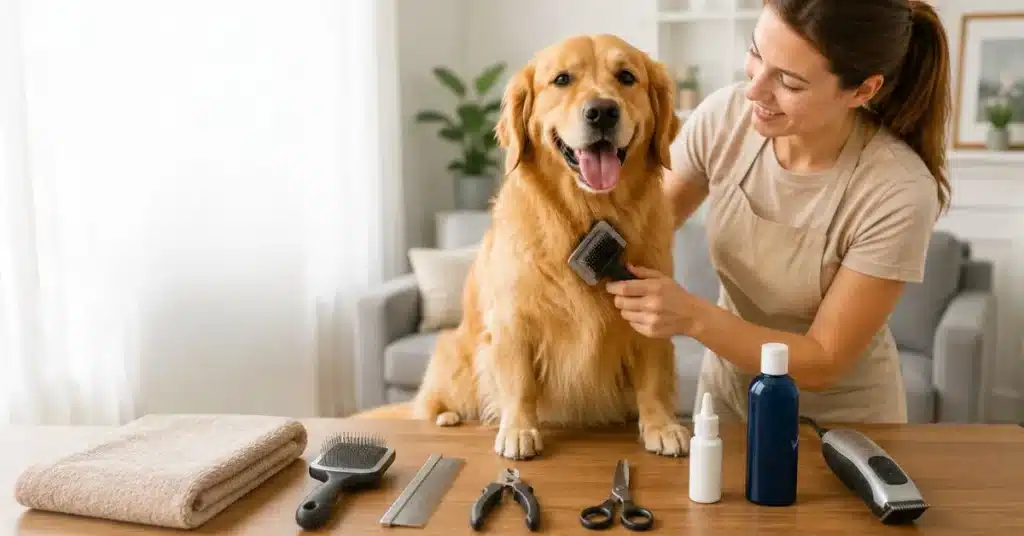
Essential Accessories for Home Grooming
Good grooming depends on more than just the clipper itself. The right dog grooming accessories can improve grooming results, reduce stress, and help you maintain your equipment properly. Many home grooming problems occur because owners focus on the clipper and overlook the tools that support the grooming process.
1. Grooming Brush
A quality grooming brush helps prepare the coat before clipping.
Benefits include:
- Removing loose hair
- Reducing shedding
- Preventing tangles
- Improving clipper performance
Brushing before clipping is one of the easiest ways to achieve smoother and more comfortable grooming sessions.
2. Grooming Comb
A grooming comb helps identify problems that may not be visible at first glance.
Combs are useful for detecting:
- Hidden tangles
- Small mats
- Uneven coat sections
- Areas that need additional brushing
They are especially valuable for medium and long-coated breeds.
3. Guide Combs
Guide combs attach to clipper blades and help control cutting length.
Benefits include:
- More consistent trimming
- Better control for beginners
- Lower risk of cutting too short
- Greater confidence during grooming
For first-time groomers, guide combs are often one of the most helpful accessories available.
4. Clipper Oil
Proper blade lubrication is essential for clipper performance.
Using clipper oil helps:
- Reduce friction
- Keep blades cooler
- Extend blade life
- Improve cutting efficiency
Regular lubrication can also help prevent overheating during longer grooming sessions.
5. Grooming Scissors
Grooming scissors provide precision in areas where clippers may be difficult to use.
They are commonly used for:
- Facial trimming
- Paw detailing
- Touch-up grooming
- Finishing work around sensitive areas
Home Grooming Essentials Checklist
Before every grooming session, make sure you have:
✅ Dog clippers
✅ Grooming brush
✅ Grooming comb
✅ Guide combs
✅ Clipper oil
✅ Towels
✅ Treats
✅ Good lighting
What Many Beginners Forget
Many owners focus on buying a more expensive clipper but overlook basic coat preparation.
In practice, brushing the coat thoroughly before clipping often improves grooming results more than upgrading to a higher-priced clipper.
Experience Tip
One of the most common complaints from home groomers is that the clipper “pulls hair.” In many cases, the actual problem is tangled fur that was not brushed out before grooming.
Building a Simple Grooming Kit
A beginner-friendly grooming kit typically includes:
- Dog clippers
- Grooming brush
- Grooming comb
- Guide combs
- Clipper oil
- Small grooming scissors
This setup is sufficient for most routine home grooming tasks.
How to Use Dog Clippers at Home Safely
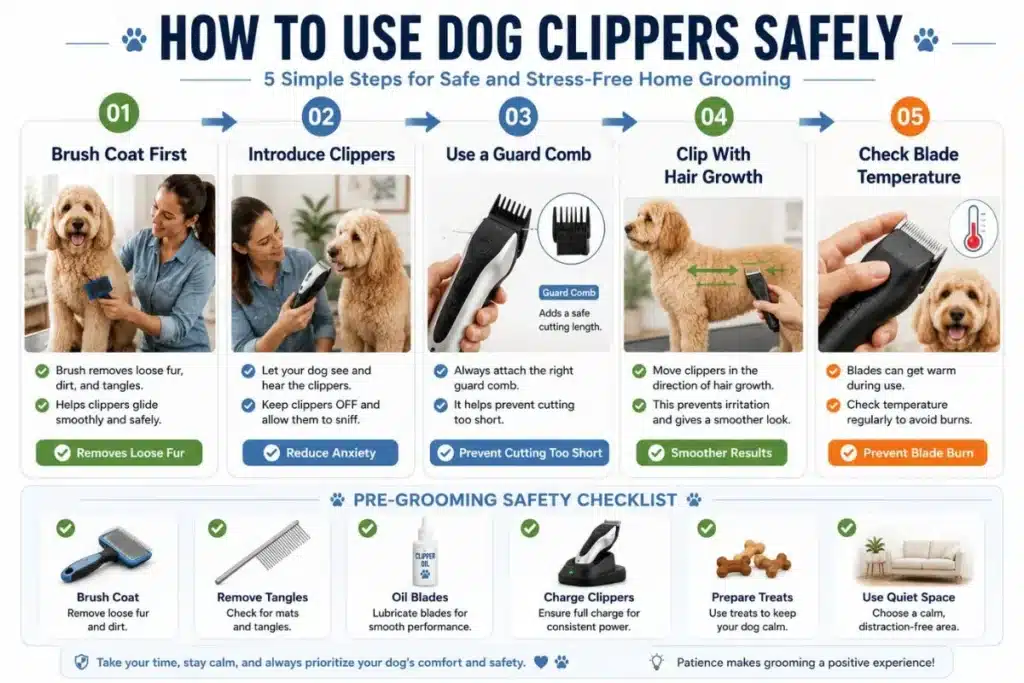
Home grooming can be a great way to maintain your dog’s coat, but safety should always come first. Most grooming accidents are not caused by the clipper itself. They happen when owners rush, skip preparation, or overlook simple safety checks.
The good news is that a few basic precautions can make grooming safer, more comfortable, and less stressful for both you and your dog.
Prepare the Coat Before Clipping
One of the most important grooming steps happens before you even turn the clippers on.
Always:
- Brush the coat thoroughly
- Remove loose hair
- Check for tangles
- Identify matted areas
- Inspect the skin for irritation
Clipping a tangled coat often causes hair pulling, uneven trimming, and increased discomfort.
Experience Tip
Many first-time groomers blame the clipper when it pulls hair. In reality, tangled fur is often the actual problem.
Introduce Clippers Gradually
Dogs that have never seen grooming clippers may become nervous when they hear the sound.
Instead of starting immediately:
- Turn the clipper on briefly.
- Let your dog hear the sound.
- Reward calm behavior.
- Repeat over several short sessions.
This gradual approach helps many dogs become more comfortable with grooming equipment.
Simple Noise Test
Before your first grooming session:
✅ Turn the clipper on
✅ Allow your dog to investigate
✅ Reward calm behavior
✅ Repeat for several days if needed
If your dog is especially sensitive to sound, you may benefit from our guide to Best Quiet Dog Clippers for Anxious Dogs.
Start With a Larger Guard Comb
When learning to groom at home, it is usually safer to begin with a longer cutting length.
Starting too short increases the risk of:
- Uneven appearance
- Accidental nicks
- Removing more coat than intended
Many experienced groomers recommend making several gradual passes rather than trying to achieve the final length immediately.
Groom in the Direction of Hair Growth
For most routine grooming tasks, clipping with the direction of hair growth creates a smoother appearance and reduces irritation.
Going against the coat can produce a shorter cut, but it may also increase the chance of uneven results for beginners.
Check Blade Temperature Frequently
One of the most overlooked safety concerns is blade heat.
During longer grooming sessions, clipper blades may become hot because of friction.
Blade Heat Test
Every 5–10 minutes:
- Turn off the clipper.
- Touch the blade to the inside of your wrist.
- If it feels uncomfortably hot, stop and allow it to cool.
This simple test can help prevent clipper burn and improve your dog’s comfort.
Warning Signs of Overheating
- Dog pulling away from the clippers
- Sudden sensitivity
- Excessive licking after grooming
- Red or irritated skin
If you notice any of these signs, stop grooming and inspect the blade temperature.
Be Careful Around Sensitive Areas
Certain parts of the body require extra caution.
These include:
- Face
- Eyes
- Ears
- Paw pads
- Tail base
- Sanitary areas
Move slowly and use appropriate blade lengths when grooming these locations.
Pre-Grooming Safety Checklist
Before every grooming session, take a few minutes to confirm everything is ready.
✅ Brush the coat
✅ Remove tangles
✅ Check blade condition
✅ Oil the blades if needed
✅ Prepare treats
✅ Choose a quiet location
✅ Check battery level
✅ Keep fresh water available
Safety Reminder
Home grooming works well for many dogs, but severe matting, skin conditions, or highly anxious behavior may require professional grooming assistance.
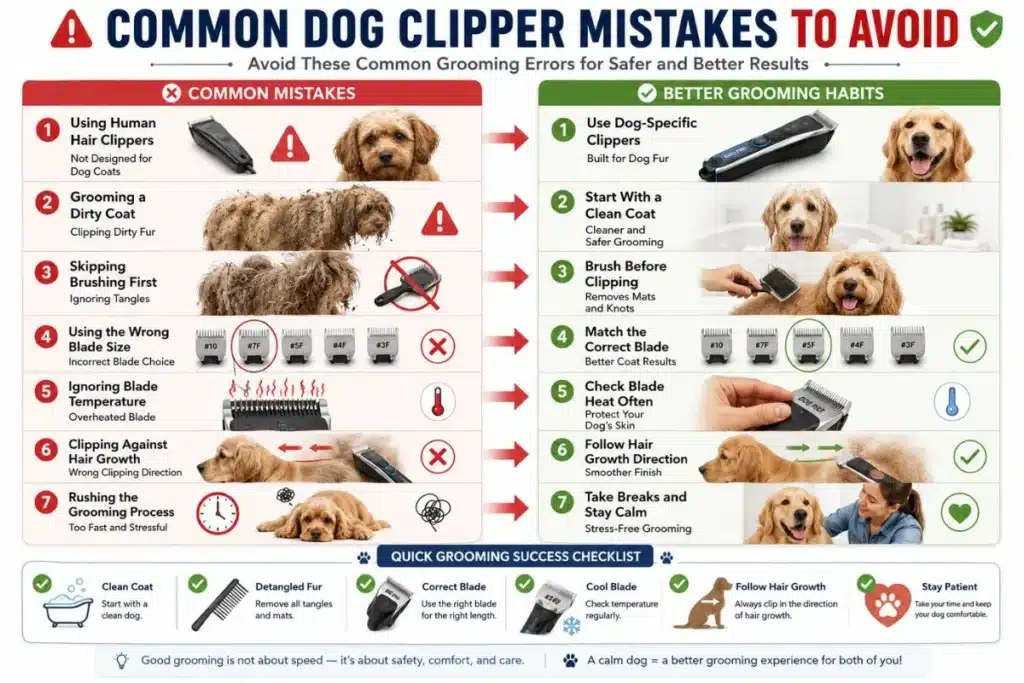
Many grooming problems are completely preventable. Understanding the most common dog clipper mistakes can save time, improve grooming results, and create a safer experience for your dog.
Mistake 1: Using Human Hair Clippers
This is one of the most common beginner mistakes.
Human hair clippers are designed for human hair texture and often struggle with dense dog coats.
Common problems include:
- Hair pulling
- Overheating
- Uneven trimming
- Longer grooming sessions
For best results, always use clippers designed specifically for dogs.
Mistake 2: Clipping a Dirty Coat
A dirty or poorly prepared coat can reduce grooming performance significantly.
Problems may include:
- Faster blade wear
- Reduced cutting efficiency
- Increased friction
- Uneven trimming
Brushing and basic coat preparation should always happen before clipping.
Mistake 3: Skipping Brushing
Many owners underestimate how important brushing is before grooming.
Mats and tangles can:
- Catch in the blades
- Pull on the skin
- Make grooming uncomfortable
- Increase clipping time
Even the best dog clipper performs poorly on a tangled coat.
Mistake 4: Ignoring Blade Heat
Hot blades are responsible for many avoidable grooming problems.
Owners often become focused on finishing the grooming session and forget to monitor blade temperature.
Make blade checks part of your regular grooming routine.
If your blades frequently become hot, our guide on Dog Clippers Getting Hot Too Fast may help identify the cause.
Mistake #5: Choosing the Wrong Clipper for the Coat
A lightweight clipper may work perfectly on a short-haired dog but struggle with:
- Thick coats
- Curly coats
- Double coats
- Matted fur
Matching the clipper to the coat type is one of the most important grooming decisions.
If you’re unsure which clipper is best for your dog’s coat, review the Coat Type Matching Guide earlier in this article.
Mistake 6: Rushing the Grooming Session
Dogs usually respond better to calm, shorter grooming sessions.
Instead of trying to finish everything at once:
- Take breaks
- Offer treats
- Stay patient
- Work gradually
This approach is especially helpful for puppies, rescue dogs, and nervous dogs.
Mistake 7: Skipping Maintenance
Even high-quality dog clippers require routine maintenance.
Dirty blades and lack of lubrication can lead to:
- Poor cutting performance
- Excessive blade heat
- Reduced blade lifespan
- More frequent grooming problems
Regular cleaning and lubrication help keep clippers performing properly.
For maintenance tips, see our guide on How to Clean and Maintain Dog Clippers.
Quick “What to Avoid” Checklist
❌ Using human hair clippers
❌ Clipping tangled or matted fur
❌ Ignoring blade heat
❌ Skipping brushing
❌ Choosing the wrong blade or clipper
❌ Rushing grooming sessions
❌ Forgetting clipper maintenance
Experience Tip
One of the most common complaints from home groomers is that the clipper “doesn’t work properly.” In many cases, the real issue is tangled fur, dirty blades, poor maintenance, or using the wrong clipper for the coat type—not the clipper itself.
Maintenance Tips for Dog Clippers
Regular maintenance is one of the easiest ways to improve clipper performance, extend blade life, and prevent common grooming problems. Many issues that owners blame on the clipper—such as hair pulling, poor cutting performance, or overheating—are often caused by inadequate maintenance.
Fortunately, basic clipper care only takes a few minutes after each grooming session.
Remove Hair After Every Use
Loose hair can accumulate between blade teeth and inside clipper components.
After each grooming session:
- Turn off the clipper.
- Remove excess hair.
- Use a cleaning brush to clear debris.
This simple habit helps maintain cutting efficiency and reduces unnecessary blade wear.
Clean the Blades Regularly
Dirty blades create additional friction and can reduce grooming performance.
Benefits of regular blade cleaning include:
- Smoother cutting
- Reduced overheating
- Longer blade life
- More consistent grooming results
Keeping blades clean is one of the simplest ways to improve clipper performance.
Apply Clipper Oil
Clipper oil reduces friction between moving blade components.
Regular lubrication helps:
- Keep blades cooler
- Reduce wear
- Improve cutting efficiency
- Extend blade lifespan
Most manufacturers recommend applying oil regularly, especially after cleaning.
Store Clippers Properly
Proper storage protects both the clipper and its blades.
Store your clippers:
✅ In a dry location
✅ Away from moisture
✅ In a protective case when possible
Avoid storing grooming equipment in humid environments, which can increase the risk of corrosion and blade damage.
Inspect Blades Before Grooming
Before each grooming session:
- Check for blade damage
- Check for dullness
- Confirm blades are secure
- Verify cleanliness
A quick inspection can help prevent many common grooming issues before they start.
5-Minute Clipper Maintenance Routine
After every grooming session:
✅ Remove loose hair
✅ Brush debris from blades
✅ Wipe down equipment
✅ Apply clipper oil
✅ Store properly
This simple routine can significantly improve clipper performance and help reduce maintenance-related problems over time.
Experience Tip
Many owners replace dog clippers because they believe the clipper has stopped working properly. In reality, dirty blades, lack of lubrication, or poor maintenance are often the real cause of declining performance.
Know When Maintenance Isn’t Enough
Even well-maintained dog clippers have limits.
If blades become:
- Damaged
- Severely dull
- Consistently hot despite cleaning
- Unable to cut efficiently
Replacement parts or professional servicing may be necessary.
Troubleshooting Common Dog Clipper Problems
Even with the right equipment and preparation, grooming challenges can still happen. The good news is that most dog clipper problems have simple causes and practical solutions.
Understanding how to identify and fix these issues can help make home grooming safer, more effective, and less stressful for both you and your dog.
Why Are My Dog Clippers Pulling Hair?
Hair pulling is one of the most common complaints among home groomers.
Possible causes include:
- Dull blades
- Tangled or matted fur
- Dirty blades
- Insufficient blade lubrication
- Using the wrong clipper for the coat type
What to Do
✅ Brush the coat thoroughly before grooming
✅ Remove mats whenever possible
✅ Clean the blades
✅ Apply clipper oil
✅ Verify that the clipper is suitable for your dog’s coat
Experience Tip
In many cases, hair pulling is caused by tangles rather than a defective clipper. Proper coat preparation often solves the problem immediately.
For a deeper diagnosis, see our guide on Why Are My Dog Clippers Pulling Hair.
Why Are My Dog Clippers Not Cutting Properly?
If the clipper is running but not removing hair effectively, several issues may be responsible.
Common Causes
- Dull blades
- Incorrect blade installation
- Clogged blade teeth
- Coat debris trapped in the blade
- Low battery power
Quick Fixes
✅ Clean the blade
✅ Check blade alignment
✅ Recharge the battery
✅ Lubricate moving parts
✅ Replace worn blades if necessary
If cleaning and lubrication do not solve the problem, read our guide on Dog Clippers Not Cutting Hair Properly.
Why Do Dog Clippers Get Hot?
Clipper blades naturally generate heat because of friction.
However, excessive heat can make grooming uncomfortable and increase the risk of skin irritation.
Causes of Overheating
- Lack of lubrication
- Dirty blades
- Long grooming sessions
- High friction from thick coats
How to Reduce Heat
✅ Apply clipper oil regularly
✅ Take breaks
✅ Clean blade debris
✅ Keep spare blades available if grooming frequently
Quick Heat Check
Touch the blade to the inside of your wrist.
If it feels uncomfortably hot for your skin, it is likely too hot for your dog as well.
For more solutions, see Dog Clippers Getting Hot Too Fast.
My Dog Is Scared of Clippers
Some dogs become nervous when they hear clipper sounds or feel blade vibrations.
This is especially common among:
- Puppies
- Rescue dogs
- Dogs with limited grooming experience
What Helps
✅ Introduce the sound gradually
✅ Reward calm behavior
✅ Keep sessions short
✅ Use quieter clippers
✅ Remain calm and patient
Many dogs become more comfortable over time when grooming is introduced slowly.
Can I Groom a Matted Dog at Home?
Light matting can sometimes be managed at home with patience and the right grooming tools.
However, severe matting may:
- Pull painfully on the skin
- Hide skin problems
- Increase injury risk
- Make clipping difficult and uncomfortable
If mats are extensive or very close to the skin, professional grooming may be the safer option. The ASPCA offers additional guidance on grooming matted coats and recognizing when professional help may be needed.
You may also find our Best Dog Clippers for Matted Hair guide helpful when dealing with challenging coats.
Trust Reminder
Home grooming is ideal for routine coat maintenance, but severe matting, skin conditions, or extreme anxiety may require professional assistance.
FAQs About Dog Clippers for Home Grooming
What dog clippers are best for home grooming?
The best dog clippers depend on your dog’s coat type, grooming frequency, and experience level. Beginners often do well with easy-to-use cordless models, while thick or curly coats may require more powerful clippers.
Can I use human hair clippers on my dog?
No. Human hair clippers are designed for human hair and may pull dog fur, overheat quickly, or struggle with dense coats. Dog-specific clippers are generally safer and more effective.
Are cordless dog clippers better than corded models?
Neither option is automatically better. Cordless clippers offer greater mobility and convenience, while corded clippers provide consistent power and are often preferred for thicker coats or longer grooming sessions.
What blade size should I use for my dog?
The ideal blade size depends on your dog’s coat, grooming goals, and the area being trimmed. Many groomers commonly use a #10 blade for general maintenance and sanitary trimming.
How often should I clip my dog?
Clipping frequency varies by breed and coat type. Dogs with continuously growing coats, such as Poodles and Doodles, usually require more frequent grooming than short-haired breeds.
Can dog clippers hurt a dog?
Dog clippers are generally safe when used correctly. Problems typically occur when blades become too hot, mats are clipped improperly, or grooming is rushed.
Why do dog clipper blades get hot?
Blade friction naturally creates heat during grooming. Regular cleaning, lubrication, and short breaks can help prevent overheating.
Can I groom a matted dog with clippers?
Minor matting may be manageable at home, but severe matting can be difficult and uncomfortable to remove safely. Professional grooming assistance may be the safer option in some cases.
What type of dog clippers are best for thick coats?
Dogs with thick or double coats often benefit from clippers with stronger motors and durable blades. Heavy-duty or professional-grade models generally perform better on dense fur.
How do I keep my dog calm during grooming?
Introduce clippers gradually, use positive reinforcement, keep sessions short, and groom in a quiet environment. Many dogs become more comfortable when grooming is introduced slowly over time.
Key Takeaways for Home Grooming Success
Choosing the right dog clippers for home grooming starts with understanding your dog’s coat type, grooming needs, and comfort level. There is no single clipper that works perfectly for every dog, which is why selecting the right tool and blade combination matters.
By learning the different types of dog clippers, matching them to your dog’s coat, and following basic grooming safety practices, you can make home grooming safer, easier, and less stressful. Small steps such as brushing before clipping, checking blade temperature, and using the correct blade size can often make a bigger difference than buying a more expensive clipper.
For most dog owners, successful home grooming is a skill that improves with practice. Start slowly, focus on your dog’s comfort, and don’t be afraid to take breaks when needed. With the right preparation and equipment, home grooming can become a simple and rewarding part of your dog’s regular care routine.
Ready to take the next step? Explore our Dog Grooming for Beginners guide to learn the essential grooming, hygiene, brushing, bathing, and coat care practices every dog owner should know.