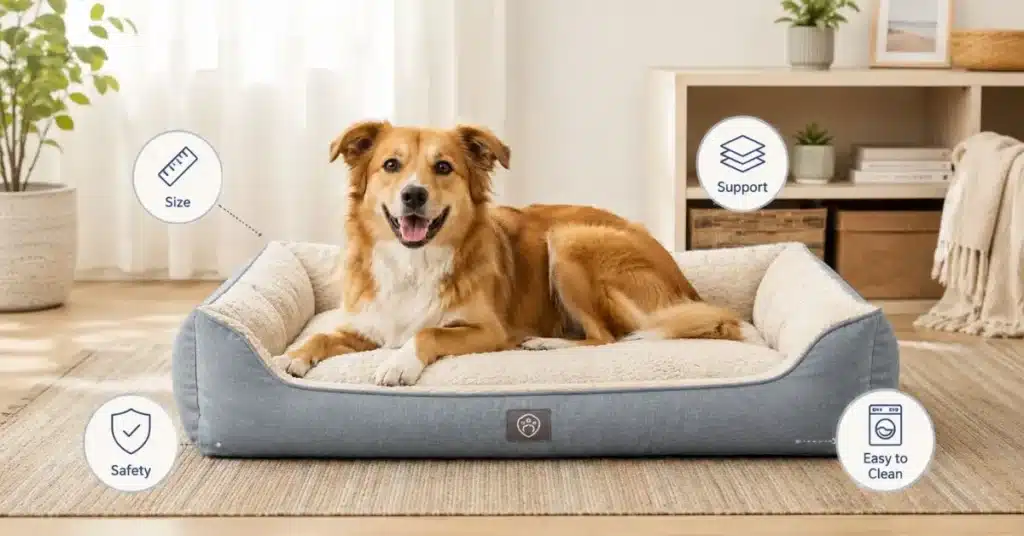
To choose a dog bed, start with your dog’s size, sleeping style, age, and support needs. A good dog bed should give your dog enough room to stretch, feel comfortable for daily sleep, and be easy to clean.
If you are a beginner dog owner, choose a washable dog bed with safe materials, proper support, and a shape that matches how your dog naturally sleeps.
Quick Dog Bed Choosing Checklist
Before you buy any dog bed, check these basic points first. A bed may look soft and cute online, but it still needs to match your dog’s size, sleeping style, age, weight, and cleaning needs.
Use this quick dog bed checklist before choosing one:
- Is the bed large enough for your dog to stretch comfortably?
- Does the bed match your dog’s natural sleeping style?
- Is the support strong enough for your dog’s age and weight?
- Does it have a removable cover or machine washable cover?
- Does the bed have a non-slip bottom for smooth floors?
- Is it safe for a puppy or a dog that likes to chew?
- Does it have strong seams and a hidden zipper?
- Is there any strong chemical smell when you open it?
- Can you clean hair, dirt, odor, drool, and accidents easily?
- Will the bed fit your home, crate, or usual dog sleeping area?
For most beginner dog owners, the safest starting point is a washable dog bed with proper size, enough support, safe materials, and easy cleaning.
If you are setting up your home for a new dog, a dog bed should be part of your basic dog accessories for beginners checklist.
Why Choosing the Right Dog Bed Matters
A dog bed is not just a soft place to sleep; it can affect your dog’s comfort, hygiene, and daily routine. For new owners, it is one of the essential dog accessories for new owners because it gives your dog a clear place to rest instead of always sleeping on the floor, sofa, or your bed.
The right dog sleeping area can help your dog feel more settled at home. It gives them a personal resting space where they can nap, relax, and stay out of busy areas. It can also help protect your furniture and floor from dog hair, dirt, odor, and scratches.
A good bed can be especially helpful for a senior dog or large dog because they may need more body support than a small young dog. But the bed still needs to fit properly. If it is too small, too flat, too slippery, or hard to clean, your dog may avoid it.
A dog bed can support daily comfort, but it cannot fix pain, anxiety, arthritis, hip problems, or medical issues by itself. If your dog seems stiff, painful, or suddenly refuses to lie down, talk to your vet.
Choose the Right Dog Bed Size
A soft bed can still be a bad bed if your dog cannot fit on it properly. The right dog bed size should let your dog lie down, turn around, curl up, and stretch without hanging off the edge.
Before buying, think about your dog’s body length, sleeping position, and weight. A small mistake in size can make even a good-quality bed uncomfortable.
Measure Your Dog First
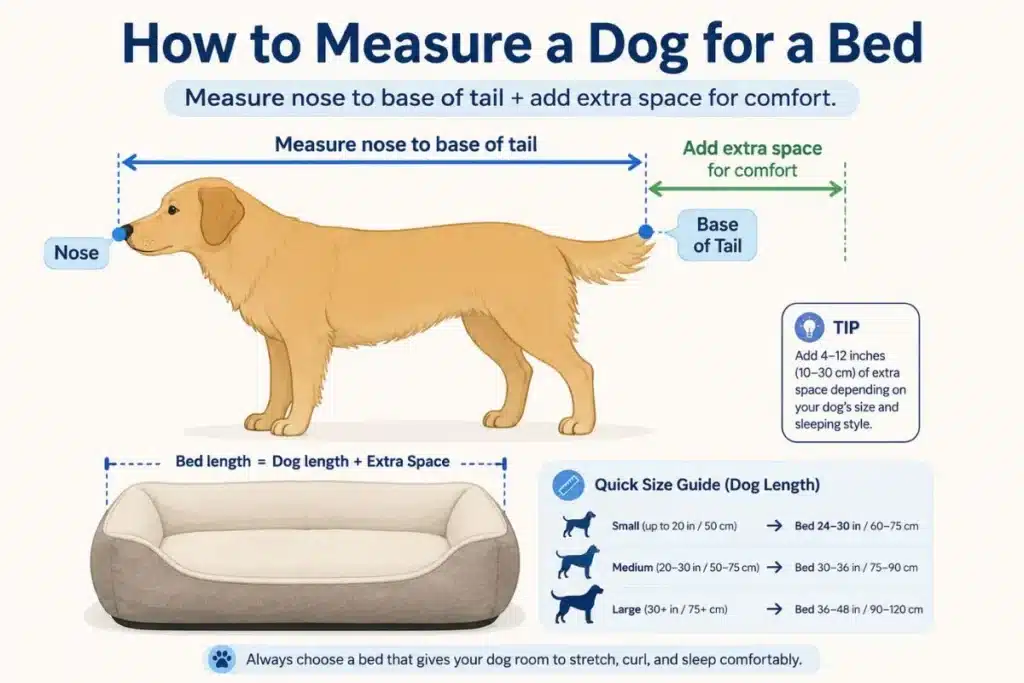
The easiest way to choose the right size is to measure your dog for a bed before buying. Measure your dog from the nose to the base of the tail while they are standing or lying naturally.
This nose to tail measurement gives you a better idea of the bed length your dog needs. Also watch how your dog sleeps for a few days. Some dogs sleep curled up, while others stretch their whole body across the floor.
If your dog likes to stretch out, choose a bed with more length and width. If your dog curls up most of the time, a round, donut, or bolster dog bed may feel more comfortable.
Add Extra Space for Stretching
Do not choose a bed that is exactly the same size as your dog’s body. It may look fine in the product photo, but your dog still needs room to stretch and change position.
A dog that stretches out will usually need a larger mattress-style bed. A curled sleeper may feel safer in a bed with raised sides, but the bed still should not feel tight.
As a simple rule, choose a bed that gives your dog extra space around the body. If you are unsure, it is usually better to go slightly bigger than too small.
Check Weight Capacity and Thickness
Size is not only about length and width. You also need to check the bed’s weight capacity and thickness, especially for a large dog bed.
A large or heavy dog needs a bed with thick foam, high-density foam, or strong support. If the foam becomes flat and your dog almost touches the floor, the bed may not give enough support.
This is more important for large dogs, senior dogs, or dogs that sleep for long hours. A supportive dog bed should hold your dog’s body without collapsing too much.
Signs the Bed Is Too Small
Your dog may not tell you directly, but their behavior can show that the bed is too small.
Common signs include:
- Your dog’s head or legs hang off the edge
- Your dog avoids the bed and sleeps on the floor
- Your dog cannot turn around comfortably
- Your dog sleeps half on the bed and half on the floor
- Your dog cannot stretch naturally
- The bed looks flat or crowded when your dog lies down
If you notice these signs, the bed may not match your dog’s real size or sleeping style. In that case, choose a larger bed with better dog bed dimensions, stronger support, and enough space for your dog to rest comfortably.
Match the Bed to Your Dog’s Sleeping Style
Your dog’s sleeping position can tell you what bed shape they may like most. Some dogs stretch out like a sprawler, while others curl up tightly like a ball. So instead of choosing only by looks, match the bed with your dog’s natural dog sleeping style.
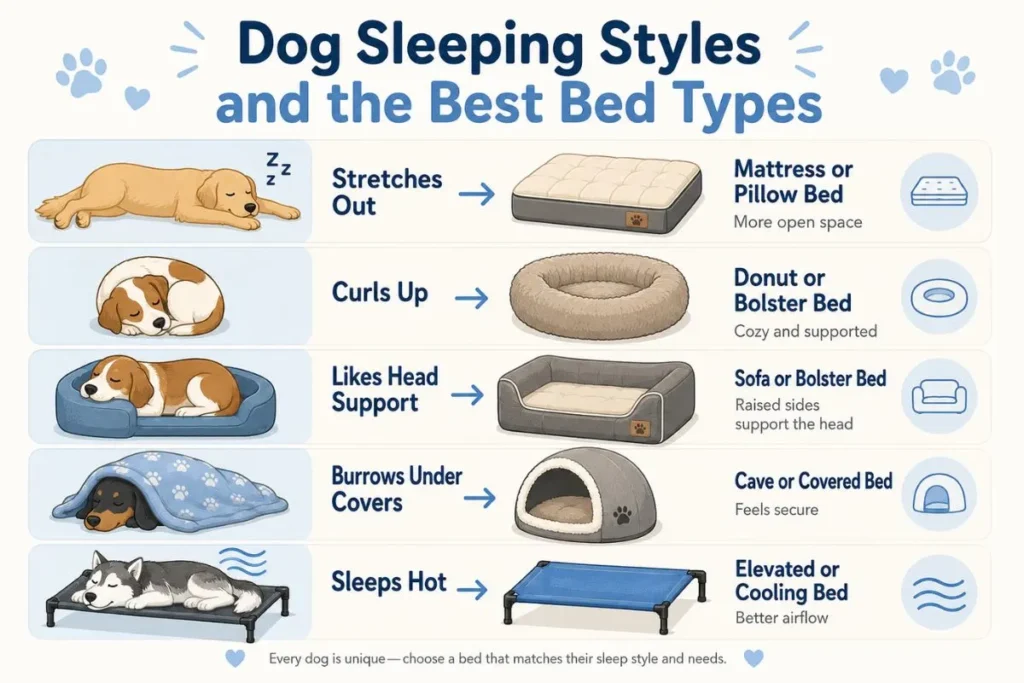
| Dog sleeping habit | Better bed type | Why |
| Stretches out | Mattress or pillow dog bed | Gives open space |
| Curls up | Donut or bolster dog bed | Feels cozy and supported |
| Likes head support | Sofa or bolster bed | Raised sides support the head |
| Hides under blankets | Cave or covered bed | Helps burrowers feel secure |
| Sleeps hot | Elevated or cooling dog bed | Gives better airflow |
For Dogs That Stretch Out
If your dog likes to stretch their legs and body while sleeping, choose a mattress dog bed, lounger bed, or pillow dog bed. These beds give more open space and do not force your dog into one position.
This type is often better for large dogs, adult dogs, and dogs that sleep on their side.
For Dogs That Curl Up
If your dog sleeps curled like a ball, a donut dog bed or bolster dog bed may feel more comfortable. The raised edges can give a cozy, protected feeling.
A bolster bed vs pillow bed comparison can help if you are confused between a flat open bed and a bed with raised sides.
For Dogs That Like to Burrow
Some dogs like to hide under blankets or sleep in a covered space. For these dogs, a cave dog bed or covered bed may work well.
This is common with some small dogs and dogs that like a warm, enclosed sleeping area. Just make sure the bed is not too hot or too tight.
For Hot Sleepers
If your dog often sleeps on cool floors, moves away from blankets, or seems uncomfortable in warm weather, they may be a hot sleeper. In that case, an elevated dog bed or cooling dog bed can help with airflow.
Choose by Age, Weight, and Health Needs
A puppy, adult dog, and senior dog may not need the same type of bed. Your dog’s age, weight, chewing habit, and health condition can change what kind of dog bed will be most comfortable.
Use this quick guide before choosing:
| Dog type | Helpful bed features | Note |
| Puppy | Washable cover, durable fabric, safe seams | Puppies may chew or have accidents |
| Adult dog | Right size, comfort, easy cleaning | Match the bed to sleeping style |
| Senior dog | Supportive foam, low-entry design | Does not replace vet care |
| Large dog | Thick foam, strong base | Cheap foam may flatten fast |
| Heavy chewer | Reinforced seams, hidden zipper | No bed is fully chew-proof |
Puppy Dog Bed Needs
For a puppy, choose a puppy bed that is easy to clean, not too expensive, and made with durable fabric. Puppies may chew corners, scratch the surface, or have pee accidents while they are still learning.
A washable cover is very helpful here. Also check for strong seams, hidden zippers, and no loose stuffing. If you are buying your first puppy bed, you can compare options in our guide to the best dog bed for puppies.
Adult Dog Bed Needs
An adult dog usually needs a bed that matches their size, sleeping style, and daily routine. If your dog stretches out, a flat mattress-style bed may work better. If your dog curls up, a bolster or donut-style bed may feel more secure.
For most adult dogs, the best choice is a bed with enough space, comfortable support, and an easy-clean cover.
Senior Dog Bed Needs
A senior dog or older dog may need more support than a young adult dog. Look for supportive foam, memory foam, a low-entry design, and a non-slip bottom so your dog can get on and off the bed more easily.
Large Dogs and Heavy Dogs
A large dog needs more than just a big surface. The bed also needs enough thickness and strength to hold the dog’s body without flattening too much.
Look for thick foam, a strong base, and enough room for stretching. If the foam becomes flat quickly, your dog may end up feeling the hard floor under the bed. For bigger breeds, check our guide to the best dog bed for large dogs.
Dogs With Joint or Mobility Issues
A supportive or orthopedic dog bed may help your dog rest more comfortably, but it cannot treat arthritis, hip dysplasia, pain, or serious mobility issues.
If your dog seems stiff, painful, slow to stand up, or has trouble getting on and off the bed, talk to your vet instead of relying on a bed change alone.
AKC explains that canine arthritis can cause stiffness, difficulty getting up, reduced activity, and mobility problems, and veterinary guidance is important for proper care.
Understand the Main Types of Dog Beds
Dog beds look similar online, but each type works better for different dogs. Before you choose one, it helps to understand the main types of dog beds and which dog each bed is usually best for.
| Bed type | Best for | Not best for |
| Pillow dog bed | Dogs that stretch out | Heavy chewers |
| Mattress dog bed | Dogs that need open space | Dogs that like raised sides |
| Bolster dog bed | Dogs that curl up or lean | Dogs that need full open space |
| Orthopedic dog bed | Senior dogs, large dogs, and dogs needing extra support | Puppies that chew a lot |
| Elevated dog bed | Hot sleepers, outdoor use, and better airflow | Dogs that like soft nesting |
| Crate bed | Crate-trained dogs | Dogs that need very thick support |
| Cave dog bed | Small dogs and burrowers | Large dogs or dogs that sleep hot |
| Cooling dog bed | Dogs that get warm easily | Dogs that prefer soft, cozy beds |
| Travel dog bed | Car rides, trips, and temporary sleeping spots | Daily use for dogs needing strong support |
A pillow dog bed or mattress dog bed is usually a simple choice for dogs that stretch out. These beds give open space and are easy for many dogs to use.
A bolster dog bed works better for dogs that like to curl up, rest their head, or lean against something. The raised sides can make the bed feel more secure.
An orthopedic dog bed is often useful for a senior dog, large dog, or dog that needs better body support. But it is not the best choice for every dog, especially puppies that may chew the foam.
An elevated dog bed or cooling dog bed can help dogs that sleep hot or spend time outdoors. A crate bed is better for crate-trained dogs, while a cave dog bed can suit small dogs that like to hide or burrow.
The best choice depends on your dog’s size, sleeping style, age, support needs, and where the bed will be used.
Choose Comfortable and Supportive Materials
Soft fabric feels nice, but real support comes from what is inside the bed. A good dog bed should feel comfortable on the outside and supportive enough on the inside, especially if your dog is large, older, or sleeps for long hours.
The best material depends on your dog’s age, weight, sleeping style, and chewing habit. Do not choose a bed only because it looks fluffy. A bed can look soft but still become flat quickly.
Memory Foam and Orthopedic Foam
Memory foam and orthopedic foam can be helpful for a senior dog, large dog, or dog that needs more body support. These materials can spread your dog’s weight more evenly and may feel more stable than thin padding.
But quality matters. A thin foam bed may still flatten quickly. Look for high-density foam, enough thickness, and a strong base.
An orthopedic dog bed can support comfort, but it is not a medical treatment. It cannot cure arthritis, hip problems, or pain. If your dog seems stiff or painful, ask your vet.
Polyester Fill and Pillow Beds
Some pillow dog beds use polyester fiberfill instead of foam. These beds are usually soft, lightweight, and easy to move around the house.
They can work well for some adult dogs, small dogs, or dogs that do not need heavy support. But they may flatten faster than foam beds, especially under large or heavy dogs.
If you choose a pillow-style bed, check whether the filling stays even or becomes lumpy after use.
Cover Materials
The cover material also matters. Common options include fleece cover, cotton cover, microfiber, canvas, nylon, and other polyester fabrics.
A soft fleece or microfiber cover may feel cozy for dogs that like warmth. A breathable fabric can be better for dogs that sleep hot. For puppies or chewers, stronger materials like canvas or durable nylon may last longer.
If your dog sheds a lot, gets dirty after walks, or has accidents, choose a cover that is removable and easy to wash.
Non-Slip Bottom and Reinforced Seams
A non-slip bottom is important if the bed will sit on tile, wood, or other smooth floors. If the bed slides when your dog steps on it, your dog may feel unsafe, especially if they are older or nervous.
Also check the stitching, seams, and zipper. Puppies and chewers can pull at weak spots, so look for durable stitching, reinforced seams, and a hidden zipper when possible.
Pick a Dog Bed That Is Easy to Clean
A dog bed that is hard to wash can become a smell, hair, and dirt problem fast. Dogs bring in pet hair, mud, dust, drool, and sometimes pee accidents, so cleaning should be part of your buying decision from the start.
Look for a washable dog bed with a removable cover if possible. A removable cover is easier to wash than a full bed, especially if the inside has foam. For many owners, choosing the best washable dog bed is more practical than choosing a bed only because it looks soft or stylish.
A machine washable cover is helpful for regular cleaning, but always follows the bed’s care label, because some covers can go in the washing machine while memory foam or orthopedic inserts may need hand washing or spot cleaning.
A waterproof liner can also be useful for puppies, senior dogs, or dogs that sometimes have urine accidents. It helps protect the inner foam from moisture, odor, and stains. But remember, waterproof and water-resistant are not always the same.
Also check whether the foam insert can be cleaned safely. Some foam inserts should not go in the washing machine because they can break apart or lose shape. After washing, let the bed dry fully before your dog uses it again. A damp bed can create bad odor, mildew, or skin irritation.
Quick tip: Before buying, check if the cover comes off, whether it is machine washable, and whether the foam insert can be cleaned safely.
Dog Bed Safety Checklist Before Buying
Comfort matters, but dog bed safety matters too—especially if you have a puppy, a heavy chewer, or a dog that likes to scratch and pull fabric.
A bed may look soft and cozy, but before buying, check the materials, seams, zipper, smell, and overall build quality.
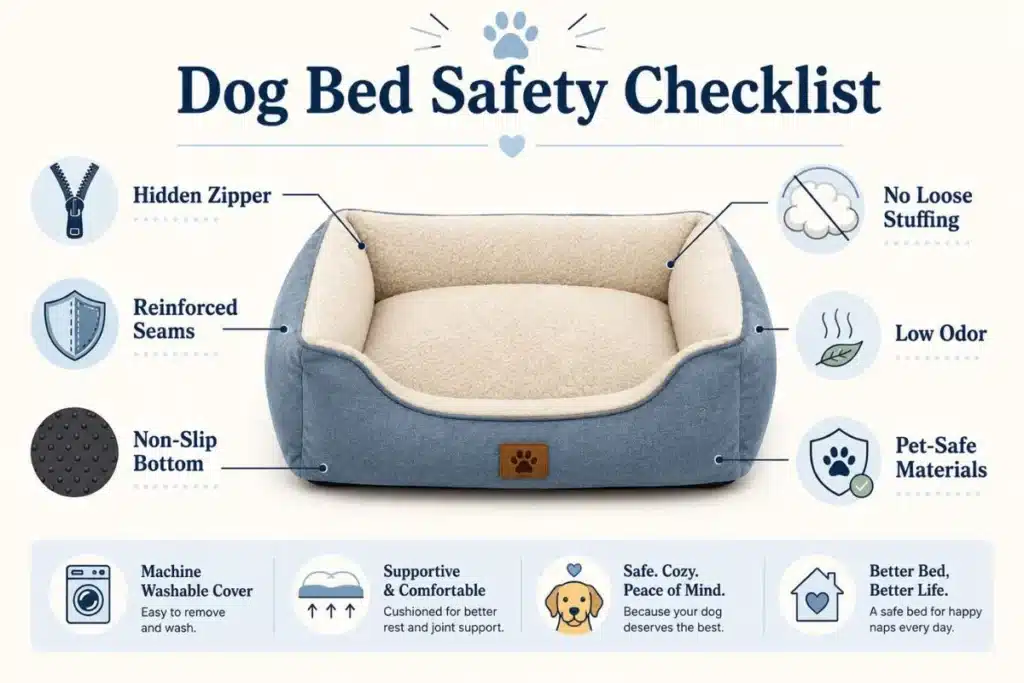
Use this quick safety checklist:
- Does the bed have a strong chemical smell?
- Are the materials described as pet-safe or low-VOC?
- If it uses foam, does the brand mention CertiPUR-US?
- If it uses fabric, does it mention OEKO-TEX STANDARD 100?
- For stain-resistant or water-resistant covers, does the brand mention PFAS-free materials?
- Are the seams strong and well stitched?
- Is the zipper hidden or covered?
- Is there any loose stuffing or exposed foam?
- Does the bed have a non-slip bottom?
- Is it safe for your dog’s chewing habits?
For puppies and heavy chewers, avoid beds with loose fabric, weak seams, exposed zipper pulls, or stuffing that can come out easily. These parts can become a choking hazard if your dog tears the bed apart.
For stain-resistant or water-resistant dog beds, check the product label because the EPA notes that PFAS in stain- and water-repellent products can appear in household fabrics such as carpets, upholstery, clothing, and other fabrics
Also be careful with beds that have a very strong smell. A light packaging smell can happen with some new products, but a strong chemical smell is a reason to check the label, air the bed out, or choose another option.
Look for clearer safety details such as non-toxic dog bed, pet-safe materials, low-VOC foam, or tested fabric claims.
Waterproof or stain-resistant beds can be useful for puppies, senior dogs, or dogs with accidents. But do not assume every waterproof bed is unsafe. Just check the material label, avoid strong chemical smells, and choose trusted brands when possible.
What to Avoid When Choosing a Dog Bed
Most wrong dog bed purchases happen because owners ignore one simple thing: the dog’s real habit. A bed may look soft, cute, or expensive, but it still may not work if it does not match your dog’s size, sleeping style, cleaning needs, or chewing habit.
Use this table to avoid the most common dog bed mistakes:
| Common mistake | Why it is a problem | Better choice |
| Buying a dog bed too small | Your dog cannot stretch or turn around comfortably | Measure your dog first |
| Choosing only by looks | Your dog may not use the bed | Match the bed to your dog’s size and sleep style |
| Ignoring cleaning | Hair, dirt, smell, and drool can build up fast | Choose a washable cover |
| Buying a bed that is too soft | Body support may be weak, especially for large or senior dogs | Pick supportive foam |
| Ignoring chewing habits | Stuffing, weak seams, or zippers can become risky | Check seams, zipper, and fabric strength |
| No non-slip bottom | The bed may slide on wood, tile, or smooth floors | Choose an anti-skid or non-slip bottom |
A good dog bed should fit your dog’s body, support their weight, and be easy to clean. It should also feel safe when your dog steps on it, especially if your dog is older, nervous, or still a puppy.
If your dog avoids the bed, sleeps half on the floor, chews the corners, or the bed smells bad after a few days, the problem may be the bed choice—not your dog.
Simple Dog Bed Fit Test
After choosing a bed, use this simple dog bed fit test to see if it actually fits your dog. You do not need any special tool. Just watch how your dog lies down, moves, and reacts to the bed.
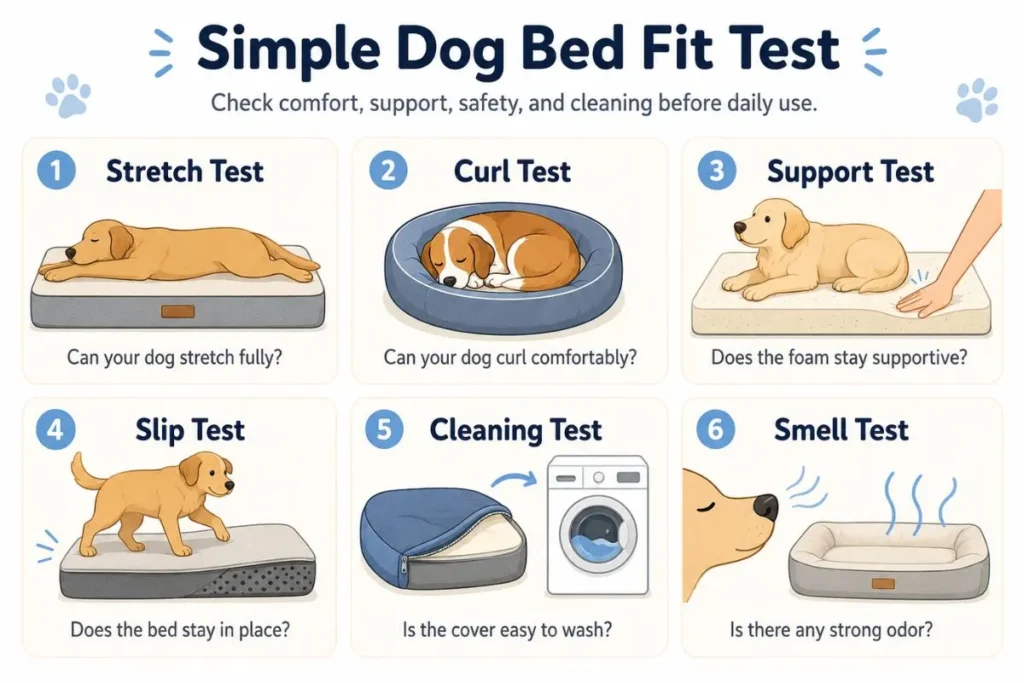
Stretch Test
First, check if your dog can stretch fully on the bed. Your dog’s head, legs, or back should not hang off the edge.
If your dog sleeps half on the bed and half on the floor, the bed may be too small. A good bed should give enough space for your dog to lie down naturally.
Curl Test
Next, watch if your dog can curl up comfortably. Some dogs like to sleep in a tight ball, especially small dogs or dogs that enjoy cozy spaces.
If your dog curls up but still looks squeezed, the bed may be too narrow. A donut or bolster-style bed may work better for a natural curled sleeping position.
Support Test
Press your hand into the bed and then watch what happens when your dog lies down. If the foam becomes too flat and your dog’s body almost touches the floor, the bed may not have enough support.
This support test is more important for a large dog, senior dog, or dog that sleeps for long hours. A dog bed flattened too quickly may feel soft at first but uncomfortable later.
Slip Test
Place the bed where your dog will actually use it. Then check if it moves when your dog steps on it.
If the bed slides on wood, tile, or smooth floors, your dog may feel unsafe. A bed with a non-slip bottom is better for older dogs, nervous dogs, and active puppies.
Cleaning Test
Before using the bed daily, check the cleaning test. Can you remove the cover? Is it washable? Is the care label clear?
If the bed has foam inside, check whether the foam can be spot cleaned or if only the cover can be washed. A bed that is hard to clean can become a smell and hair problem fast.
Smell Test
Finally, do a quick smell test. A light packaging smell can happen with some new beds, but a strong chemical smell is a warning sign.
If the smell is strong, check the material label, air the bed out, or choose another option. If your dog avoids bed use after you place it down, smell, size, slipperiness, or poor support could be the reason.
Real Examples: Which Dog Bed Fits Which Dog?
Real dog situations make choosing much easier. Instead of guessing from product photos, think about your dog’s age, size, sleeping style, and daily habits.
Use these examples to match your dog with a better bed choice:
| Dog situation | Better bed choice | Why |
| Puppy chews everything | Washable durable bed | Accidents and chewing are common |
| Senior Labrador | Orthopedic mattress bed | Large body and joint support needs |
| Small dog curls up | Donut or bolster bed | Cozy and secure feel |
| Dog sleeps hot | Elevated or cooling bed | Better airflow |
| Dog pees sometimes | Waterproof liner + washable cover | Easier cleaning |
| Dog stretches out | Flat mattress bed | More open space |
| Dog sleeps in crate | Crate mat or crate bed | Fits crate space |
If you have a puppy, focus on a puppy bed that is easy to wash and strong enough for light chewing. Puppies can have accidents, so a soft luxury bed is not always the best first choice.
For a senior or large dog, support matters more. A senior dog bed or large dog bed with thicker foam can help your dog rest more comfortably. If your older dog needs extra support, check our guide to the best orthopedic dog bed for older dogs.
For a small dog that curls up, a bolster dog bed or donut bed may feel warmer and more secure. If your dog is small and likes cozy spaces, you may also like our guide to the best dog bed for small dogs.
For dogs that sleep hot, an elevated dog bed or cooling bed can give better airflow. For dogs with accidents, choose a waterproof liner and washable cover so cleaning stays simple.
Where Should You Place a Dog Bed?
Sometimes the dog bed is fine, but the location is wrong. If the bed is in a noisy, too hot, too cold, or isolated place, your dog may ignore it even if the bed is comfortable.
The best dog sleeping area should feel calm, safe, and easy for your dog to reach. Many dogs like being near the family, so a corner of the living room or bedroom can work well. This gives your dog a resting spot without making them feel separated.
Choose a quiet corner where people do not walk all the time. Avoid placing the bed in the middle of a busy walkway, near loud appliances, or beside a door that opens and closes often.
Also think about temperature. Do not place the bed in direct heat, strong sunlight, or beside a heater. At the same time, avoid cold drafts, wet floors, or areas near an open window in cold weather.
If your dog sleeps in a crate, use a proper crate bed or crate mat that fits the space without bunching up. The bed should not block the crate door or make the crate too tight.
For an anxious dog, a calm area can help. A quiet corner near the family is often better than a far isolated room.
When Should You Replace a Dog Bed?
Even a good dog bed will not stay supportive forever. Over time, the foam can flatten, the cover can tear, and the bed may stop giving your dog the comfort they need.
You may need to replace a dog bed if you notice these signs:
- The dog bed flattened and no longer supports your dog’s body
- The foam is thin, lumpy, or uneven
- There is exposed foam or loose stuffing
- The bed has a torn cover or broken zipper
- A bad smell stays even after washing
- Your dog avoids the bed and sleeps somewhere else
- Your dog looks stiff after sleeping
- The bed slides, bends, or loses its shape
- Stuffing comes out when your dog scratches or chews it
A flat or damaged bed may look harmless, but it can become uncomfortable. If your dog is a senior dog, large dog, or has support needs, a bed that has lost its shape may not be enough anymore.
If your dog suddenly seems stiff, painful, or avoids lying down, do not assume the bed is the only issue. A vet check may be needed, especially if your dog has trouble standing, walking, or resting comfortably.
Dog Bed Maintenance Tips
The right bed lasts longer when you maintain it properly. Good dog bed maintenance also helps control pet hair, dirt, smell, and moisture before they become a bigger problem.
To keep your dog’s bed clean and comfortable, follow these simple tips:
- Vacuum pet hair and dust from the bed at least once a week.
- Wash the removable cover regularly if the bed has one.
- Use an unscented detergent if your dog has sensitive skin or allergies.
- Always dry fully before letting your dog use the bed again.
- Check the seams, zipper, and foam for damage.
- Use a waterproof liner for puppies, senior dogs, or dogs with accidents.
- Keep the bed in a dry place to help prevent mildew and bad odor.
- Replace the bed when the foam becomes flat or the support is gone.
A washable cover makes maintenance much easier, especially if your dog sheds a lot or comes inside with dirty paws. If the cover is not removable, check the care label to see whether the full bed can be washed or only spot cleaned.
Never let your dog sleep on a damp bed. Moisture can lead to odor control problems, mildew, and skin irritation.
Final Recommendation: What Dog Bed Should You Choose?
The best dog bed is the one that fits your dog’s real body, habits, and cleaning needs. Do not choose only by price, softness, or style. A good bed should match your dog’s size, sleeping style, age, support needs, and how easy it is to clean.
Use this simple guide before making the final choice:
| Dog need | Usually good choice | Limitation |
| Most dogs | Washable mattress or bolster bed | Must fit your dog’s size |
| Puppy | Durable washable bed | May still chew it |
| Senior dog | Orthopedic or supportive dog bed | Does not replace vet care |
| Large dog | Thick supportive bed | Cheap foam may flatten fast |
| Hot sleeper | Elevated or cooling dog bed | Some dogs dislike raised beds |
| Heavy chewer | Reinforced durable bed | No bed is fully chew-proof |
For most beginner dog owners, the safest starting point is a properly sized, washable dog bed with enough support and a shape that matches your dog’s natural sleeping style.
If your dog is still growing, choose a practical puppy bed that is easy to wash. For an older dog, a senior dog bed or orthopedic dog bed may be more comfortable. For a bigger breed, choose a large dog bed with thicker foam and stronger support.
If your dog chews beds, look for a chew-resistant dog bed with reinforced seams, hidden zippers, and durable fabric. Just remember that no bed is completely chew-proof, so supervision still matters.
The right choice is not always the most expensive bed. It is the bed your dog can use comfortably, safely, and daily.
Once you choose the right dog bed, you may also need the right collar, leash, bowls, toys, and grooming tools. For the full setup, check our dog accessories for beginners guide.
Common Questions About Dog Beds
Below are some common questions about choosing a dog bed, answered in a simple and practical way.
What size dog bed should I get?
Choose a dog bed size that lets your dog lie down fully and stretch comfortably. Measure from nose to tail and add a little extra space for movement. A slightly bigger bed is usually better than a too-small one.
How do I measure my dog for a bed?
Measure your dog from nose to base of the tail while they are lying or standing naturally. Also observe their sleeping position—whether they stretch or curl—then add extra room based on that.
Should a dog bed be bigger than the dog?
Yes, in most cases a dog bed should be slightly bigger than your dog. This gives enough space to stretch, turn, and sleep comfortably. But it should not be too large, or your dog may feel less secure.
What type of dog bed is best for most dogs?
For many dogs, a washable mattress dog bed or bolster dog bed works well. The best choice still depends on your dog’s size, age, and sleeping style.
Are orthopedic dog beds worth it?
Orthopedic dog beds can be helpful for senior dogs, large dogs, or dogs that need extra support. However, they are not a medical treatment and cannot replace vet care.
Is memory foam good for dogs?
Memory foam can be good if it is high-quality and thick enough. It is often useful for large dogs or older dogs, but puppies or heavy chewers may need more durable options.
Should a dog bed have a removable cover?
Yes, a removable cover makes cleaning much easier. It helps manage pet hair, dirt, drool, odor, and accidents, especially for daily use.
How often should you wash a dog bed?
It depends on usage. If your dog sheds a lot or has accidents, wash it more often. Always follow the care label and use a gentle cleaning routine.
How often should you replace a dog bed?
Replace a dog bed when it becomes flattened, smelly, torn, or uncomfortable. If your dog starts avoiding it or wakes up stiff, it may also be time for a new one.