
To choose a dog collar, start with fit, comfort, and safety.
A good dog collar should sit snugly on your dog’s neck without choking. It should allow the two-finger fit, hold an ID tag securely, and feel comfortable for daily use.
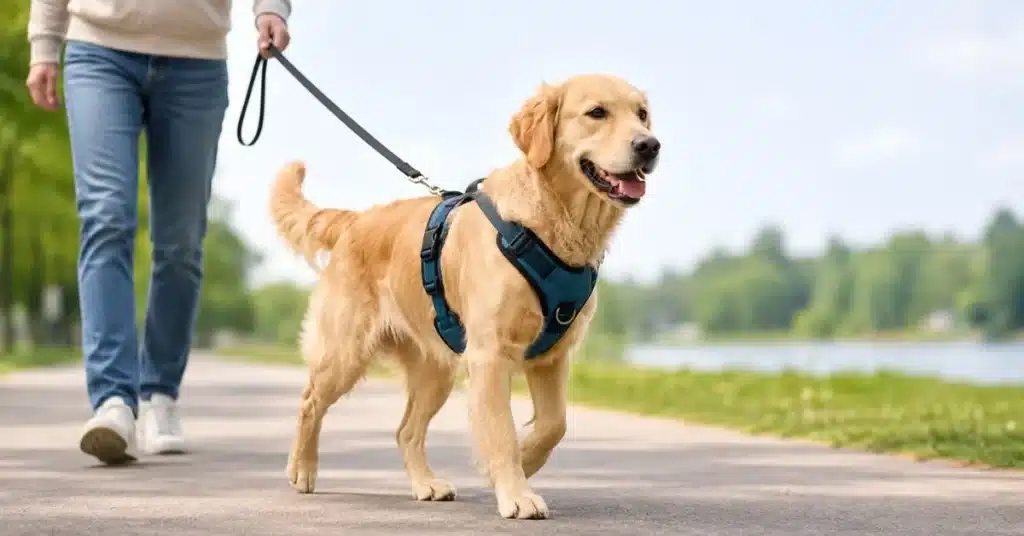
For many dogs, a flat adjustable collar works well. But puppies, strong pullers, or dogs that slip out of collars may need a different collar type or a harness for safer walks.
In this guide, you’ll learn how to measure your dog’s neck, compare collar types, choose the right material, and avoid common beginner mistakes.
Quick Answer Box
For most dogs, a flat adjustable collar is a good everyday choice for ID tags and normal daily use. Choose a lightweight collar for a puppy, a martingale collar for a dog that slips out easily, and a dog harness for dogs that pull hard on walks.
The safe collar is the one that fits snugly, does not rub your dog’s neck, and matches your dog’s size, comfort, and daily behavior.
Quick Decision Guide: Which Dog Collar Should You Choose?
Choosing the right collar starts with your dog’s real-life use, not just the design. The best option depends on your dog’s age, size, walking behavior, and comfort needs.
| Dog situation | Better option |
| Calm adult dog | Flat adjustable collar |
| Growing puppy | Lightweight adjustable collar |
| Dog slips out easily | Martingale collar or harness |
| Strong puller | Harness for walks, collar for ID |
| Night walks | Reflective collar or LED collar |
| Sensitive skin | Soft padded collar |
A flat collar is usually a simple choice for many calm dogs because it can hold ID tags and works well for everyday use. But the same collar may not be right for every dog.
For a puppy, choose a lightweight puppy collar that can be adjusted as your dog grows. For a strong puller, a collar may put pressure on the neck, so a harness is often a better walking option.
If your dog has sensitive skin, look for a soft padded collar with smooth edges. And if your dog often walks at night, a reflective collar or LED collar can help improve visibility.
For a deeper breakdown of each collar style, read our Types of Dog Collars Explained guide.
Why Choosing the Right Dog Collar Matters
A dog collar is not just a style item. It plays an important role in your dog’s safety, comfort, and daily control.
A good collar can hold your dog’s ID tag, connect to a leash through the D-ring, and help keep your dog identifiable if they ever get lost. It also gives you basic control during short walks, quick outdoor breaks, or everyday handling.
But the wrong collar can create problems. A collar that is too tight may cause neck pressure, rubbing, or skin irritation. A collar that is too loose can increase the escape risk, especially if your dog pulls backward or gets scared outside.
That is why a comfortable dog collar should fit securely without choking, feel light enough for daily use, and match your dog’s size and behavior. The goal is not just to choose a collar that looks good, but one that keeps your dog safe and comfortable.
Types of Dog Collars Explained
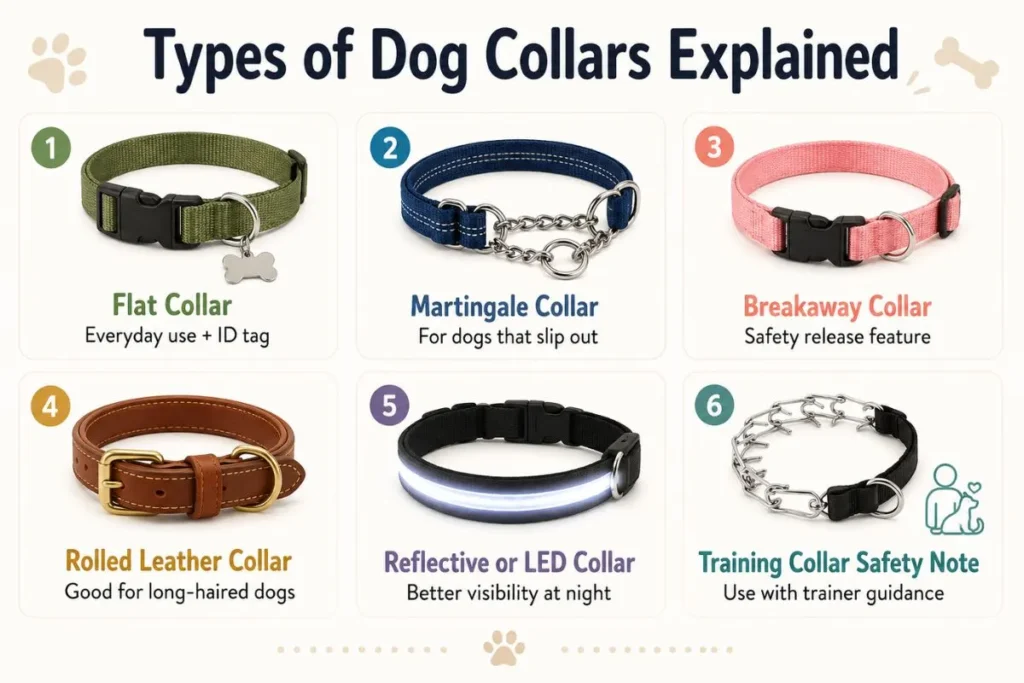
Not every collar is made for the same purpose. Before buying one, it helps to understand the basic types of dog collars and when each one may be useful.
Flat Collar
A flat collar is the most common everyday dog collar. It usually comes with a buckle collar or quick-release collar design, making it easy to put on and take off.
This type of collar works well for many calm dogs because it can hold an ID tag and has a D-ring for leash attachment. It is a simple option for daily use, but it may not be the best walking choice for dogs that pull hard.
Martingale Collar
A martingale collar is also called a limited-slip collar. It can be helpful for escape-prone dogs that often slip out of regular collars.
This collar gently tightens within a limited range when the dog pulls backward. However, proper fit is very important. A martingale collar should not choke your dog, and it should not be left on without supervision.
Breakaway Collar
A breakaway collar has a safety release feature. It is designed to open if the collar gets caught on something.
This can help reduce snagging risk, especially around the home or yard. But a breakaway collar may not be the best option for leash walking because it can release under pressure.
Rolled Leather Collar
A rolled leather collar can be a good choice for some long-haired dogs. Its rounded shape may help reduce hair flattening and matting around the neck.
However, a leather collar usually needs more care than nylon. It may not be the best choice for dogs that swim often or get dirty every day.
Reflective or LED Collar
A reflective collar or LED collar can be helpful for night walks or low-light areas. These collars improve visibility, especially near roads, sidewalks, or dark yards.
Look for collars with reflective stitching or a built-in light feature. But remember, visibility is only one part of safety. The collar still needs to fit properly.
Training Collar Safety Note
Some collars are sold as training collars, but beginners should be careful. If you are new to dog training, avoid choosing shock collars, prong collars, or choke chains on your own.
These tools can cause discomfort, fear, or injury when used incorrectly. For training problems, positive reinforcement and help from a qualified trainer are usually safer starting points.
How to Measure Your Dog for a Collar
Before you buy a collar, you need the right dog collar measurement. Guessing the size can lead to a collar that is too tight, too loose, or uncomfortable for daily use.
To measure your dog, use a soft measuring tape and measure around the part of the neck where the collar normally sits. Keep the tape snug, but do not pull it too tight. You are measuring your dog’s neck circumference, not trying to tighten the collar.
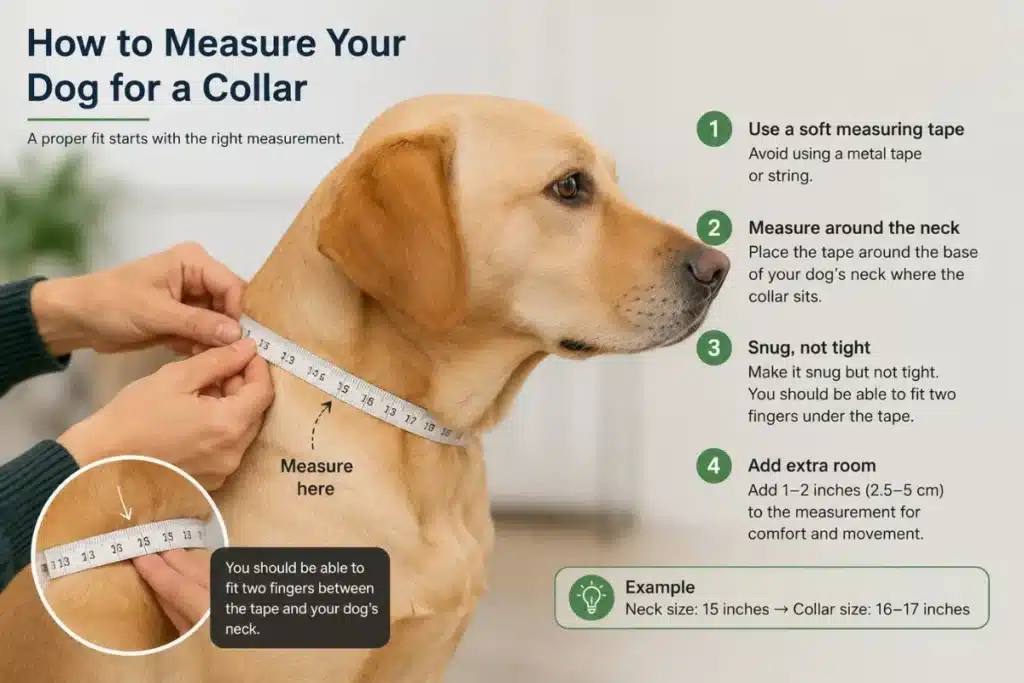
Follow these simple steps:
- Let your dog stand naturally.
- Wrap a soft measuring tape around your dog’s neck.
- Measure the area where the collar usually sits.
- Keep the tape snug, but not tight.
- Compare the number with the brand’s collar size chart.
After measuring, check the collar’s adjustable range. For example, if your dog’s neck is 15 inches, choose a collar size that includes 15 inches within its adjustment range.
After measuring, compare your result with a dog collar size chart before choosing a size. This helps you avoid buying a collar that only looks right but does not actually fit your dog safely.
When the collar arrives, check the fit again on your dog’s neck. A size chart helps, but the final test should always be how the collar fits your dog in real life.
How Should a Dog Collar Fit?
Fit matters more than color, style, or brand. A dog collar should have a snug fit, but it should never feel tight around your dog’s neck.
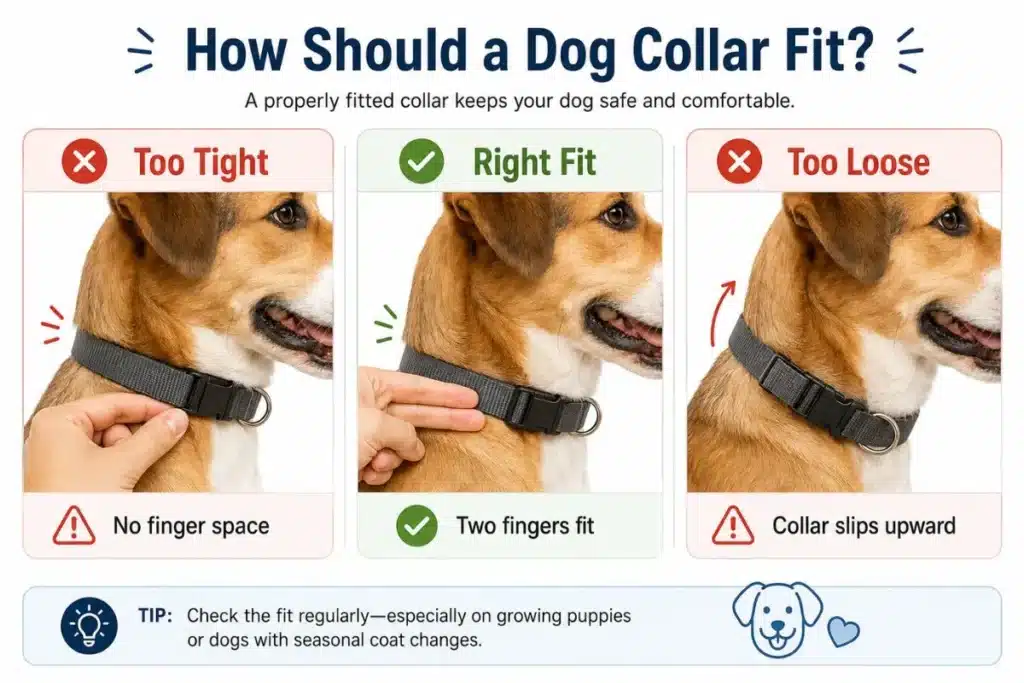
The easiest way to check the fit is the two-finger rule. After putting the collar on, you should be able to slide two fingers between the collar and your dog’s neck. Your fingers should fit comfortably, not with force.
A too tight collar can cause choking risk, neck pressure, coughing, rubbing, or redness around the neck. If your dog keeps scratching at the collar, pulls away when you touch it, or seems uncomfortable, the fit may be too tight.
A too loose collar is also unsafe. If the collar can slide over your dog’s ears or move around too much, your dog may slip out of it during a walk. This is especially risky for nervous dogs or dogs that pull backward.
Check the collar while your dog is standing naturally. The collar should stay in place, but your dog should still be able to move, breathe, and turn their head comfortably.
Safety Check:
After putting the collar on, slide two fingers between the collar and your dog’s neck. If your fingers fit comfortably, the collar is usually right. If you cannot fit them, the collar may be too tight. If you can fit three or more fingers very easily, it may be too loose.
Simple Collar Fit Tests Before Daily Use
Before using a new collar every day, do a few simple collar fit tests. These quick checks help you make sure the collar is not too tight, too loose, or uncomfortable for your dog.
Two-Finger Test
The two-finger test is the easiest way to check collar fit. After putting the collar on, slide two fingers between the collar and your dog’s neck.
Your fingers should fit comfortably. If you cannot fit two fingers, the collar may be too tight. If you can fit three or more fingers very easily, the collar may be too loose.
Movement Test
Next, do a simple movement test. Let your dog walk, sit, turn their head, and lower their head while wearing the collar.
The collar should stay in place without sliding over the ears or twisting too much. Your dog should move normally without scratching, pulling away, or acting uncomfortable.
Skin Check Test
After your dog wears the collar for a few hours, do a quick skin check. Look around the neck for redness, rubbing, hair loss, itching, or pressure marks.
If you notice any skin irritation, adjust the fit or choose a softer collar material. This is especially important for puppies, short-haired dogs, and dogs with sensitive skin.
Leash Pressure Test
Finally, attach the leash gently and watch how your dog reacts. If your dog shows coughing, gagging, or pulls hard against the collar, the leash pressure may be too much for the neck.
In that case, a harness may be safer for walks, while the collar can still be used for ID tags.
Dog Collar Size Guide
Dog collar sizes are not universal. One brand’s small may not match another brand’s small, so your dog’s real neck measurement is more important than the size label.
A puppy collar size should be lightweight and adjustable because puppies grow quickly. Check the fit often, especially during the first few months.
A small dog collar should not be too wide or heavy. Small dogs usually need a softer, lighter collar that does not put extra pressure on the neck.
A medium dog collar should balance comfort and strength. Look for an adjustable collar with a secure buckle, smooth edges, and enough room for the two-finger fit.
A large dog collar should be stronger, wider, and made with durable hardware. Large dogs may need a collar with a strong D-ring, secure buckle, and proper collar width for better support.
Also, always check the collar’s adjustable range before buying. For example, if your dog’s neck is 16 inches, choose a collar that includes 16 inches within its size range.
Best Dog Collar Materials
The material affects your dog’s comfort, cleaning routine, durability, and risk of skin irritation. The best dog collar material is not the same for every dog, so choose based on your dog’s daily lifestyle, coat type, and skin sensitivity.
| Material | Best for | Limitation |
| Nylon dog collar | Everyday use | Can rub if the edges are rough |
| Leather dog collar | Durability and classic look | Needs more care and cleaning |
| Neoprene dog collar | Soft comfort and active dogs | Can smell if not cleaned often |
| Biothane collar | Easy cleaning and water-friendly use | Quality depends on the brand |
| Reflective collar | Night walks and low-light areas | Still needs a proper fit |
A nylon dog collar is usually lightweight, affordable, and easy to find. It works well for many dogs, but check the edges and stitching because rough areas can rub your dog’s neck.
A leather dog collar can be strong and long-lasting. However, leather needs more care, especially if your dog gets wet, muddy, or plays outside often.
A neoprene dog collar is soft and comfortable, which can be helpful for dogs with sensitive skin. But it may hold a smell if you do not clean it regularly.
A Biothane-style collar or waterproof collar can be easier to wipe clean after rain, mud, or outdoor walks. Just remember that quality can vary by brand.
For dogs that walk early in the morning or at night, a reflective collar can improve visibility. Still, reflective material does not replace a safe fit.
Material Safety Note
If you choose a waterproof, coated, or stain-resistant collar, check whether the brand shares safety details such as PFAS-free, PFOA-free, lead-free hardware, skin-safe dye, or hypoallergenic material. Do not assume these claims unless the brand clearly states them.
For waterproof or coated collars, check the brand’s safety details before trusting PFAS-free claims.
How to Choose a Collar Based on Your Dog
The right collar depends on your dog’s age, size, behavior, and daily routine. A collar that works well for a calm adult dog may not be the safest choice for a puppy, a strong puller, or an escape-prone dog.
For Puppies
For puppies, choose a puppy collar that is lightweight, soft, and easy to adjust. Puppies grow fast, so an adjustable collar is important.
Avoid heavy collars, thick hardware, or stiff material. These can feel uncomfortable on a small puppy’s neck.
Check the fit at least once a week during early puppy growth. A collar that fits today may become tight quickly as your puppy grows.
For Small Dogs
A small dog collar should be soft, narrow, and light. Small dogs often have more neck sensitivity, so avoid collars with heavy buckles or rough edges.
A lightweight collar or soft collar is usually better for daily wear. The collar should hold an ID tag securely without pulling down on your dog’s neck.
For Large Dogs
A large dog collar should be strong, secure, and properly fitted. Look for a strong buckle, durable hardware, and a reliable D-ring for leash attachment.
Large dogs may also need a slightly wide collar for better support. But wider does not always mean better. The collar should still feel comfortable and should not rub the neck.
For Dogs That Pull
If your dog pulls on leash, a collar may not be the best walking tool. Strong pulling can create neck pressure, coughing, or discomfort.
For a strong puller, a harness for walking is often a safer option. You can still use a collar for ID tags, but use the harness for better control during walks.
For Dogs That Slip Out
If your dog slips out of the collar often, the collar may be too loose or the wrong type for your dog’s neck shape. This is common with some escape-prone dogs.
A properly fitted martingale collar may help some dogs that back out of flat collars. A harness can also be a safer choice for walks.
The key is proper fit. The collar should be snug enough to stay in place, but not tight enough to choke or rub your dog’s neck.
Dog Collar vs Harness: Which Is Better?
A collar and harness can both be useful, but they solve different problems. The better choice depends on your dog’s walking behavior, size, comfort, and safety needs.
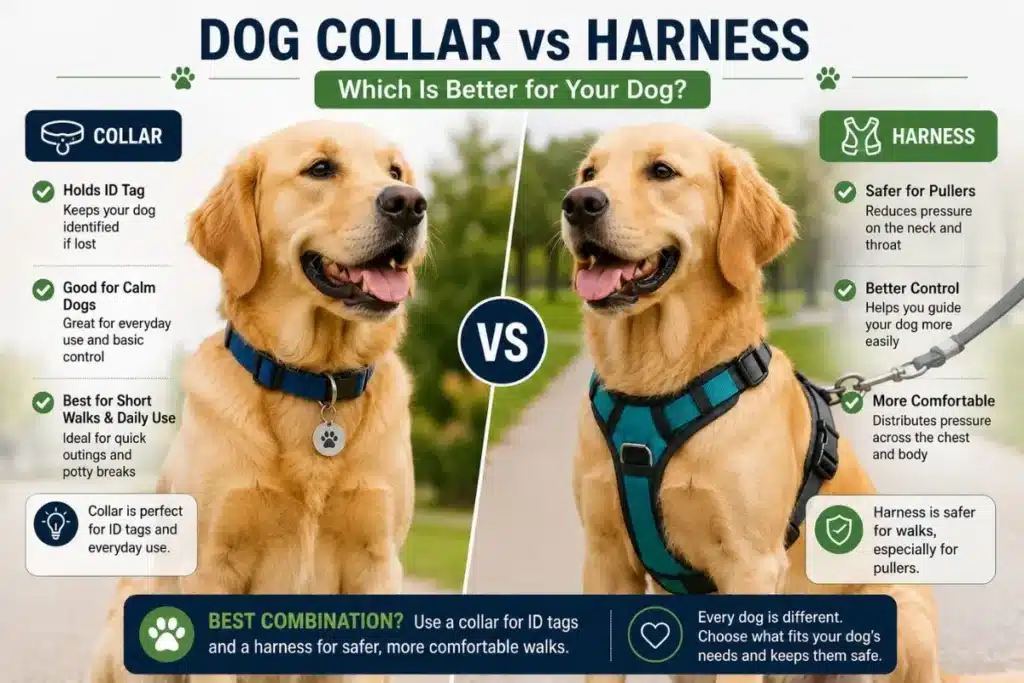
For many calm dogs, a dog collar is enough for daily use. It can hold an ID tag, help identify your dog if they get lost, and give you quick control during short walks or outdoor breaks.
But if your dog pulls hard, coughs on walks, or has neck sensitivity, a harness may be a better walking option. A harness spreads pressure across the chest and body instead of putting direct neck pressure on the throat area.
For more context, read this harness and collar safety guidance on when a harness may be safer than a collar for pulling dogs.
This is especially useful for small dogs, strong pullers, puppies learning leash manners, or dogs that get uncomfortable when pressure is placed on the neck. In these cases, a harness for dogs that pull can make walks safer and more comfortable.
That does not mean collars are bad. Many dogs can use both: a collar for ID tags and a harness for walks. This setup gives your dog identification while also improving walking safety.
So, when choosing between a collar or harness, think about how your dog behaves outside. If your dog walks calmly, a collar may work well. If your dog pulls, slips out, coughs, or shows discomfort, a harness may be the safer choice.
What to Avoid When Choosing a Dog Collar
Choosing the wrong collar can create dog collar mistakes that affect your dog’s comfort and safety. Before buying, check these common issues:
- Avoid a too tight collar because it can cause neck pressure, coughing, rubbing, or skin irritation.
- Avoid a too loose collar because your dog may slip out during a walk.
- Avoid a heavy collar for puppies or small dogs. It can feel uncomfortable and put extra pressure on the neck.
- Avoid collars with rough stitching, sharp edges, or a weak buckle. These can rub the skin or break under pressure.
- Avoid choosing a collar only because it looks cute. Fit, comfort, and safety should come first.
- Avoid using a neck collar as the main walking tool for strong pullers. A harness may be safer for walks.
- Avoid leaving training collars on all day. Good training collar safety means using training tools carefully and only when needed.
- Avoid trusting unsupported claims like non-toxic or hypoallergenic unless the brand clearly explains the material.
- Avoid ignoring warning signs like rubbing, redness, coughing, scratching, or hair loss around the neck.
Common Dog Collar Mistakes Beginners Should Avoid
Many beginner dog owners make simple collar mistakes without realizing it. The problem is that a small mistake, like the wrong collar size or a poor fit, can make your dog uncomfortable or even unsafe.
One common mistake is buying a collar only because it looks cute. Style is fine, but fit, comfort, and safety should come first. A beautiful collar is not helpful if it rubs your dog’s neck or feels too heavy.
Another common mistake is choosing the wrong size. A collar that is too tight can cause collar discomfort, coughing, rubbing, or redness. A collar that is too loose can slide over your dog’s ears and let them escape during a walk.
Puppy owners need to be extra careful. A common beginner mistake is buying a cute collar for a puppy and forgetting to recheck the puppy collar fit. Puppies grow quickly, so a collar that fits this week may feel tight later.
Some owners also forget to add an ID tag. Even if your dog usually stays close, an ID tag can help someone contact you if your dog gets lost.
Another mistake is ignoring signs of discomfort. If your dog keeps scratching at the collar, pulls away when you touch it, coughs during walks, or has hair loss around the neck, the collar may not be right.
Also, avoid using a neck collar as the main walking tool if your dog pulls hard. In that case, a harness may be safer and more comfortable.
How to Maintain and Replace a Dog Collar
A safe collar can become unsafe if it is dirty, damaged, or too small. Good collar maintenance helps keep your dog comfortable and reduces the risk of rubbing, bad smell, or weak hardware.
Clean your dog’s collar regularly, especially if your dog plays outside, gets wet, or rolls in dirt. If you are wondering how to clean dog collar materials, start by checking the brand’s care instructions. Some collars can be wiped clean, while leather or padded collars may need gentler care.
You should also check the collar’s buckle, D-ring, and stitching often. A damaged buckle or loose D-ring can make the collar unsafe, especially if you attach a leash to it. If the stitching is loose or the collar feels weak, it may be time to replace it.
For puppies, check the fit at least once a week because puppy growth can make a collar tight very quickly. For adult dogs, check the fit about once a month.
Replace the collar if it becomes a frayed collar, cracked, smelly, too tight, or weak around the buckle or leash attachment point. You should also replace it if it causes rubbing, hair loss, or skin irritation.
Quick Dog Collar Buying Checklist
Use this dog collar buying checklist before you choose a collar. It will help you pick a safe dog collar that fits well and feels comfortable for daily use.
Before buying a dog collar, check:
- The collar matches your dog’s neck size.
- It allows the two-finger fit.
- The material feels soft and comfortable.
- The buckle or clip feels secure.
- The D-ring is strong enough for leash attachment.
- The collar is not too heavy for your dog.
- It is an adjustable collar, especially for puppies.
- It has reflective details if you walk at night.
- It is easy to clean.
- It does not rub your dog’s skin.
- It can hold an ID tag safely.
A comfortable dog collar should not just look good. It should fit safely, stay secure, and match your dog’s size, behavior, and daily routine.
FAQs About Choosing a Dog Collar
What type of collar is best for most dogs?
The best type of dog collar for many dogs is a flat collar. It is simple, easy to use, and works well as an everyday dog collar for holding ID tags.
However, it is not the best choice for every dog. Dogs that pull hard, slip out easily, or have neck sensitivity may need a different collar type or a harness.
How should a dog collar fit?
A dog collar should have a snug fit, but it should not be tight. Your dog should be able to move, breathe, and turn their head comfortably.
A simple way to check the fit is to use the two-finger rule. If two fingers fit comfortably between the collar and your dog’s neck, the fit is usually right.
What is the two-finger rule for dog collars?
The two-finger rule dog collar method means you should be able to slide two fingers between the collar and your dog’s neck.
If you cannot fit two fingers, the collar may be too tight. If more than two or three fingers fit very easily, the collar may be too loose.
How do I measure my dog for a collar?
To measure the dog neck for collar sizing, use a soft measuring tape around the part of the neck where the collar normally sits.
Keep the tape snug, not tight, and write down the dog collar measurement. Then compare it with the brand’s size guide, or see our Dog Collar Size Chart if you are unsure about size.
Is a collar or harness better for walking?
For calm dogs, a collar can work well for short walks and daily ID use. But for dogs that pull hard, cough, or have neck sensitivity, a harness may be safer.
The choice depends on your dog’s walking behavior. For more detail, read our Dog Collar vs Harness guide.
What collar is best for puppies?
The best collar for puppies is usually a lightweight, soft, adjustable puppy collar. Puppies grow quickly, so the collar should not be heavy or stiff.
Check the fit often, especially during the first few months. A collar that fits this week may become tight later as your puppy grows.
Are collars safe for dogs that pull?
Collars can be safe for some dogs, but if your dog pulls on the collar hard, it can create pressure on the neck.
For strong pullers, a harness is often a better walking option. You can still use a collar for ID tags and use the harness for walks.
How often should I replace my dog’s collar?
There is no fixed rule for how often to replace dog collar, but you should replace it when it becomes damaged, too tight, smelly, frayed, or weak.
If you are wondering when to replace your dog’s collar, check the buckle, D-ring, stitching, and fit regularly. For puppies, check the fit more often because they grow fast.
Final Thoughts on Choosing the Right Dog Collar
The best dog collar is not always the most stylish one. It is the collar that gives your dog a safe fit, feels comfortable, and matches your dog’s size, behavior, and daily routine.
Start with fit and safety first. Then choose the collar type, material, and features based on your dog’s real needs. If your dog pulls hard, slips out of collars, coughs on walks, or has neck or breathing issues, a harness may be safer for walks.
If your dog has health or behavior concerns, ask a veterinarian or qualified trainer before choosing a collar for walking or training.
You can also continue with our Dog Accessories for Beginners guide if you are preparing everything for a new dog